Why Safety Leaders Can’t Ignore What Happens on the Road
A conversation on why driving risk is one of the most serious and least controlled safety exposures organizations face.
What if one of the biggest risks in your organization isn’t on the jobsite, but on the road?
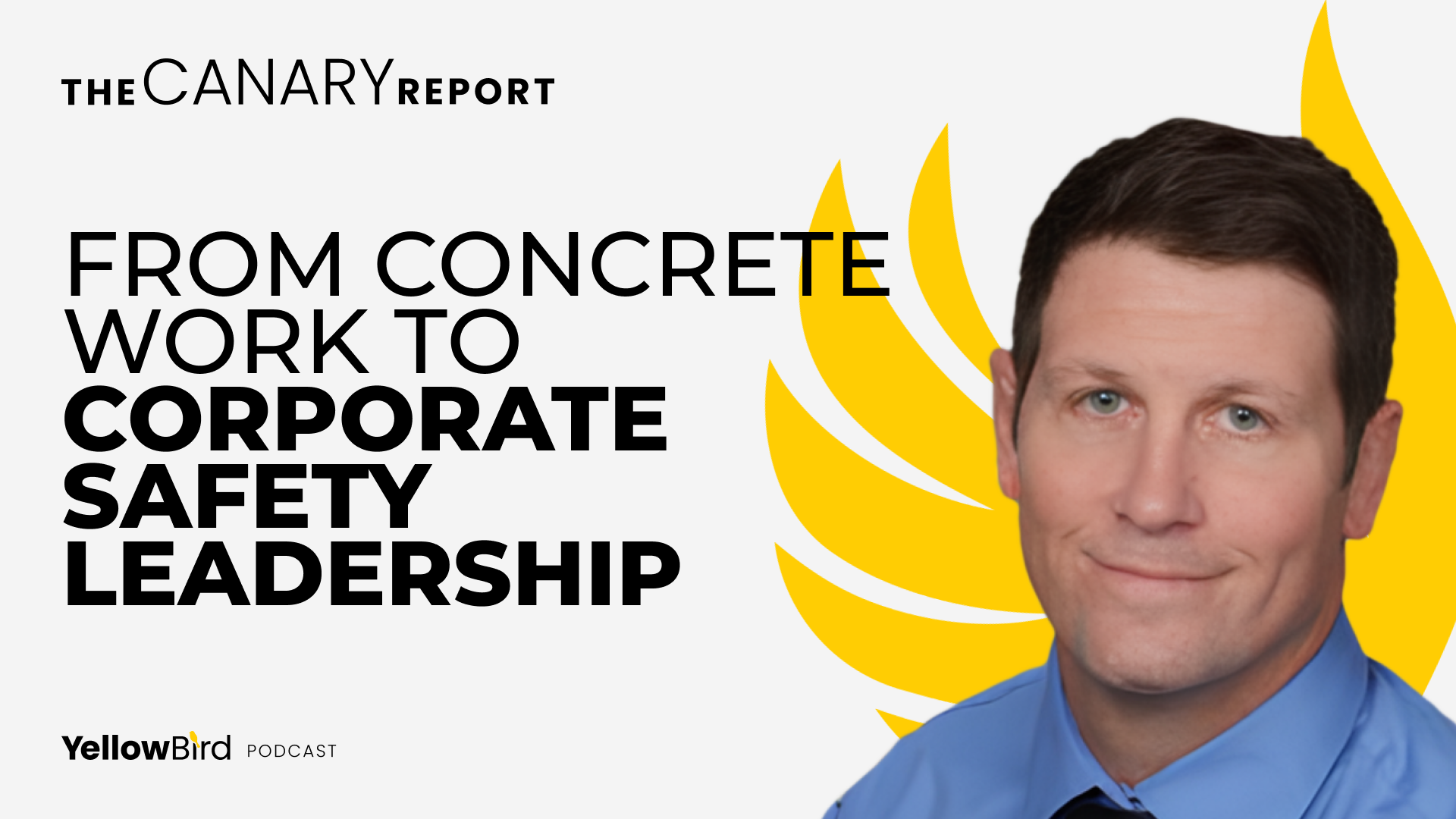
In a recent episode of The Canary Report: Safety & Risk Management, Michael Zalle sits down with Zac Elliott, Safety Director at Mead & Hunt, to unpack a reality many organizations underestimate: driving is one of the most significant and least controlled safety exposures in modern operations.
For a company like Mead & Hunt, where employees collectively log more than 5 million miles annually for business purposes, the scale of that risk is impossible to ignore. But what makes this conversation compelling isn’t just the numbers but the mindset shift required to manage that exposure effectively.
This isn’t a discussion about policies. It’s about people, behavior, and the limits of control.
The Risk You Don’t Fully Control
Unlike jobsite environments, driving introduces a unique challenge: you don’t control the conditions. Your employees are operating in dynamic, unpredictable environments. They’re sharing the road with strangers, making real-time decisions under fatigue, distraction, and time pressure. And often, they’re doing it alone.
That lack of control makes driving risk fundamentally different from other workplace hazards. Zac highlights how this plays out in practice. Even with strong policies, monitoring systems, and training programs in place, the ultimate decision still sits with the individual behind the wheel.
Because at that moment, when a notification pops up or fatigue sets in, policy is no longer the primary driver of behavior. Judgment is.
Why Distracted Driving Is a Human Problem, Not a Policy Problem
One of the most powerful moments in the conversation comes from a simple question Zac poses to his team:
How would you live with it?
How would you live with the decision to check a message if it resulted in a crash?
How would you live with the consequences if someone were injured, or worse?
This reframing shifts the conversation away from compliance and toward consequence.
The reality is, no one would ever justify that decision after the fact. No one would say the text was worth it. But in the moment, people still take that risk. Why? It’s because humans are wired for short-term rewards and long-term optimism. We believe nothing will happen until it does.
That’s why Zac emphasizes the human impact of safety decisions. Not just the risk to the individual, but the ripple effects: families, communities, and lives permanently changed by a single moment of inattention. Most effective safety messaging isn’t always technical. It’s emotional.
From the Field to Safety Leadership: Why Experience Matters
Before moving into safety leadership, Zac spent years working in concrete construction. He has experience with forming, pouring, and finishing concrete as a tradesman. That background fundamentally shaped how he approaches safety today. It gave him the credibility that many safety professionals struggle to build.
When you’ve done the work, you understand the pressures. You understand why shortcuts happen. You understand the gap between policy and reality. And most importantly, you can speak the language of the workforce.
Zac shares how, earlier in his career, he would occasionally step back into the field, literally jumping into concrete pours alongside crews. They were trust-building moments and not just symbolic gestures. Safety leadership is about influencing behavior and that influence is built on understanding.
The Balance Between Internal Ownership and External Expertise
Another important theme in the discussion is how organizations approach safety expertise.
Zac’s team handles much of their safety training internally, not just for efficiency, but to build relationships with employees. Internal training creates familiarity, builds trust, and makes safety teams more accessible. But they also recognize the limits of internal capability.
Specialized areas like electrical safety, aerial lift training, and CPR certification often require external experts. In these cases, outsourcing is a strategic decision to ensure quality and accuracy.
The takeaway isn’t choosing between internal and external. It’s knowing when each is appropriate.
Culture Isn’t a Safety Initiative, It’s the Foundation
Perhaps the most important insight from the conversation is this: You can’t build a strong safety culture without a strong company culture.
At Mead & Hunt, the foundation is simple:
- Take care of people
- Do the right thing
- Do what makes sense
They’re company values, not just catchy slogans. That distinction matters because when people feel valued, supported, and respected, safety becomes a natural extension of how they work, not an imposed requirement.
Zac reflects on how this shifted his own perspective. Earlier in his career, he struggled with the question many safety leaders face: How do we get people to care about safety?
The answer was always culture. When the organization genuinely cares about its people, safety stops being a compliance exercise and becomes a shared responsibility.
The Challenge of Scaling Culture
As organizations grow, especially through acquisitions, maintaining that culture becomes more difficult.
New teams bring different habits, expectations, and ways of working. Imposing change too quickly can create resistance. Moving too slowly can create inconsistency.
Zac describes a balanced approach: establishing non-negotiables where necessary, while gradually integrating teams into the broader culture.
Safety Leadership Is Ultimately About People
Across topics of fleet safety, training, and culture, the same theme emerges that safety is always about people and not systems. The decisions they make when no one is watching, the values they internalize, and the environments leaders create for them to succeed.
Driving risk, in many ways, is the clearest example of this.
You can’t control every road. You can’t control every variable. But you can influence how people think, how they prioritize, and how they act in critical moments. And sometimes, the most effective way to do that is through perspective rather than policy.
When someone truly understands the impact of their actions, not just on themselves, but on others, they generally don’t need to be told what to do.
🎧 Listen to the full episode here:
Apple Podcasts: https://bit.ly/4dIpSNg
Spotify:
https://bit.ly/4sz0X3k
YouTube:
https://youtu.be/40dzQQ8zcS8