The Most Important Safety Decision Happens Before the Crash
A conversation with Mazda’s Jennifer Morrison on why real safety leadership starts long before impact.
What if the most important safety decisions are the ones made long before a crash ever happens?
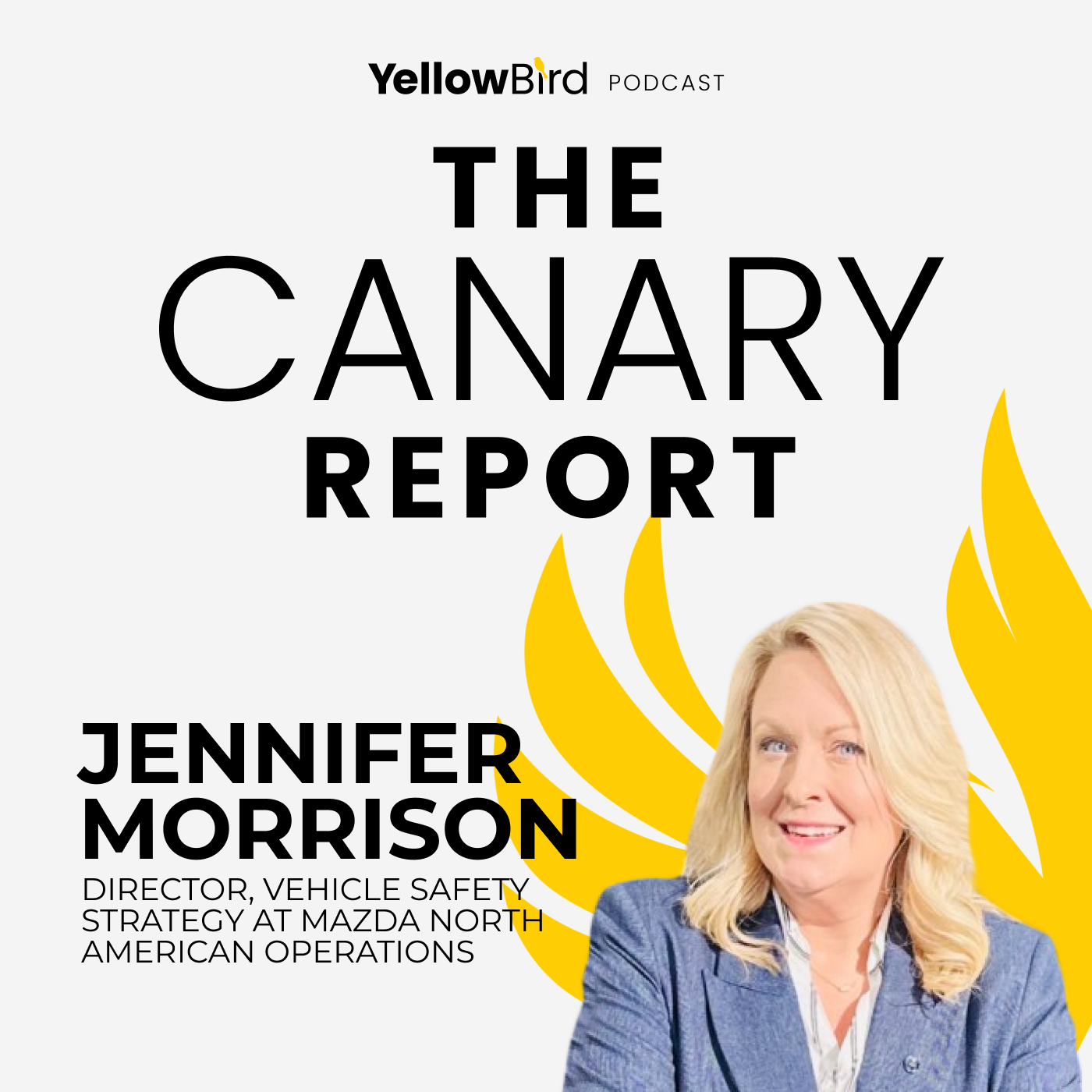
That’s the central theme of this episode of The Canary Report: Safety & Risk Management, where host Michael Zalle sits down with Jennifer Morrison, Director of Vehicle Safety Strategies at Mazda North America. With more than two decades of crash investigation experience at the NTSB and NHTSA, Jennifer brings a perspective shaped not by theory, but by real-world consequences.
The conversation moves beyond features and regulations. It focuses on a deeper leadership question: Are we designing systems to prevent harm, or are we simply getting better at responding after it occurs?
When Patterns Become a Call to Act
During her years investigating crashes, Jennifer saw the same themes repeat themselves.
High-speed rear-end collisions.
Drowsy drivers.
Impairment.
Unbelted passengers.
These weren’t isolated events. They were predictable patterns. And over time, witnessing the same preventable tragedies took a personal toll. That repetition prompted a shift in her career from analyzing what went wrong to helping ensure fewer crashes happen in the first place.
It’s a powerful reminder for safety professionals across industries: when recurring incidents appear in the data, they signal an opportunity for upstream intervention.
Prevention is not just a strategy. It’s a responsibility.
Making Safety Standard, Not a Luxury Upgrade
One of the most compelling parts of the discussion centers on Mazda’s decision to make blind spot monitoring standard across its vehicle lineup, without waiting for a federal mandate.
In many industries, advanced safety is treated as optional. Basic protection is included. Enhanced protection costs more.
Jennifer challenges that model directly. If a technology demonstrably reduces crashes and protects lives, should it really sit behind a premium tier?
This is both a moral and a business conversation. For organizations weighing cost against responsibility, the lesson is clear: when proven life-saving interventions are available, leadership means integrating them broadly, not selectively.
The broader implication extends beyond automotive design. Safety leaders in any field must ask: which of our highest-confidence protections are still optional? And why?
The Unsung Engineers Behind the Scenes
Jennifer is quick to redirect praise toward the engineers and crash-avoidance specialists designing the systems that drivers rely on every day. Hundreds of safety engineers in Japan are constantly testing, refining, and innovating technologies intended to prevent injury long before impact.
Their work is rarely visible to the public. And that invisibility is often a sign of success.
When safety functions as intended, most users never consciously notice it. But that outcome requires intentional collaboration across engineering, regulatory compliance, and real-world validation. Jennifer describes her role as a bridge,
translating innovation into U.S. regulatory alignment, Insurance Institute for Highway Safety (IIHS) performance standards, and measurable outcomes.
For compliance professionals, it’s a meaningful reframing. The role is not merely to enforce regulations. It’s to help ensure that innovation reaches the public in a way that genuinely improves safety.
Data That Changes the Conversation
The episode takes a decisive turn when discussing connected vehicle data.
Since 2018, telematics and aggregated crash data have enabled more precise measurement of real-world performance. The findings are striking: automatic emergency braking (AEB) systems are preventing more than 50% and approaching 60% of rear-end crashes.
This statistic reframes investment decisions. When a single technology can eliminate more than half of a common crash type, the debate shifts from cost to impact.
For fleet managers and risk executives, this level of validation strengthens the business case for upgrading vehicles and integrating advanced driver assistance systems (ADAS). For safety leaders, it reinforces the importance of measuring outcomes, not just compliance.
Evidence turns safety from aspiration into accountability.
The Teen Driver Dilemma
The conversation also addresses a common instinct among families and organizations alike: assigning the oldest vehicle to the least experienced driver.
While the reasoning may be practical, Jennifer encourages a more nuanced question: Does that vehicle include modern crash-avoidance technology?
Basic automatic emergency braking is now widely available, including in used vehicles manufactured within the past decade. The barrier is often not cost; it is awareness.
For those influencing vehicle procurement, whether in households or fleets, this presents a tangible opportunity. Placing inexperienced drivers in vehicles equipped with AEB can significantly reduce crash risk.
Small decisions, made intentionally, can have measurable safety outcomes.
Fleet Risk Is Workplace Risk
A particularly important insight from the episode highlights a gap many organizations overlook: driving for work is still work. Traffic incidents remain one of the leading causes of occupational fatalities. Yet fleet safety is often managed separately from broader occupational safety programs.
This separation creates vulnerability.
Organizations that apply rigorous controls to machinery, fall hazards, and confined spaces must extend that same discipline to vehicle selection, driver behavior, and crash-avoidance technology.
Fleet safety is not an ancillary issue. It is core risk management. Integrating it into an occupational safety strategy is both a legal and ethical imperative.
Technology Assists, But Humans Decide
Despite the power of modern safety systems, Jennifer emphasizes a foundational truth: the primary safety system in any vehicle remains the driver.
Speeding, distraction, impairment, and seatbelt non-use continue to drive crash severity. Advanced technologies like AEB and blind spot monitoring are critical layers of protection, but they are not substitutes for responsible behavior.
This distinction matters.
Advanced driver assistance systems are designed to support human decision-making, not replace it. As automation evolves, the role of accountability must remain central.
For safety professionals, the implication is clear: technological advancement must be paired with continued investment in behavioral training, awareness, and accountability systems.
Technology amplifies safety culture. It does not create it.
From Reaction to Leadership
At its heart, this episode is about leadership.
Jennifer’s journey from crash investigator to safety strategist reflects a broader evolution within the field. Investigations will always be necessary. But true progress comes from shifting energy upstream, designing systems that prevent harm rather than merely documenting it.
Michael Zalle frames the conversation with a consistent reminder: in safety, “wrong” has human consequences.
Moving from reaction to prevention requires bold decisions:
- Making proven life-saving systems standard.
- Using real-world data to validate effectiveness.
- Integrating fleet risk into occupational strategy.
- Reinforcing human accountability alongside technological innovation.
Safety is not a feature. It is not a marketing differentiator. And it is not simply a compliance requirement.
It is leadership in action.
For fleet operators, EHS leaders, risk managers, and executives responsible for protecting people, this episode offers both perspective and practical direction.
Because when prevention becomes the priority, safety stops being reactive.
It becomes intentional.
🎧 Listen to the full episode here:
Apple Podcasts:
https://bit.ly/4kQjrJP
Spotify:
https://bit.ly/4l2pnPR
YouTube:
https://youtu.be/ZdhtsPY0SVc