What If Your Safety Program Is Training Workers to Hide Problems?
How language, leadership, and small design choices determine whether workers practice safety or just perform it.
What if the biggest threat to your safety programs isn't a hazard on the floor but the language you use to describe it?
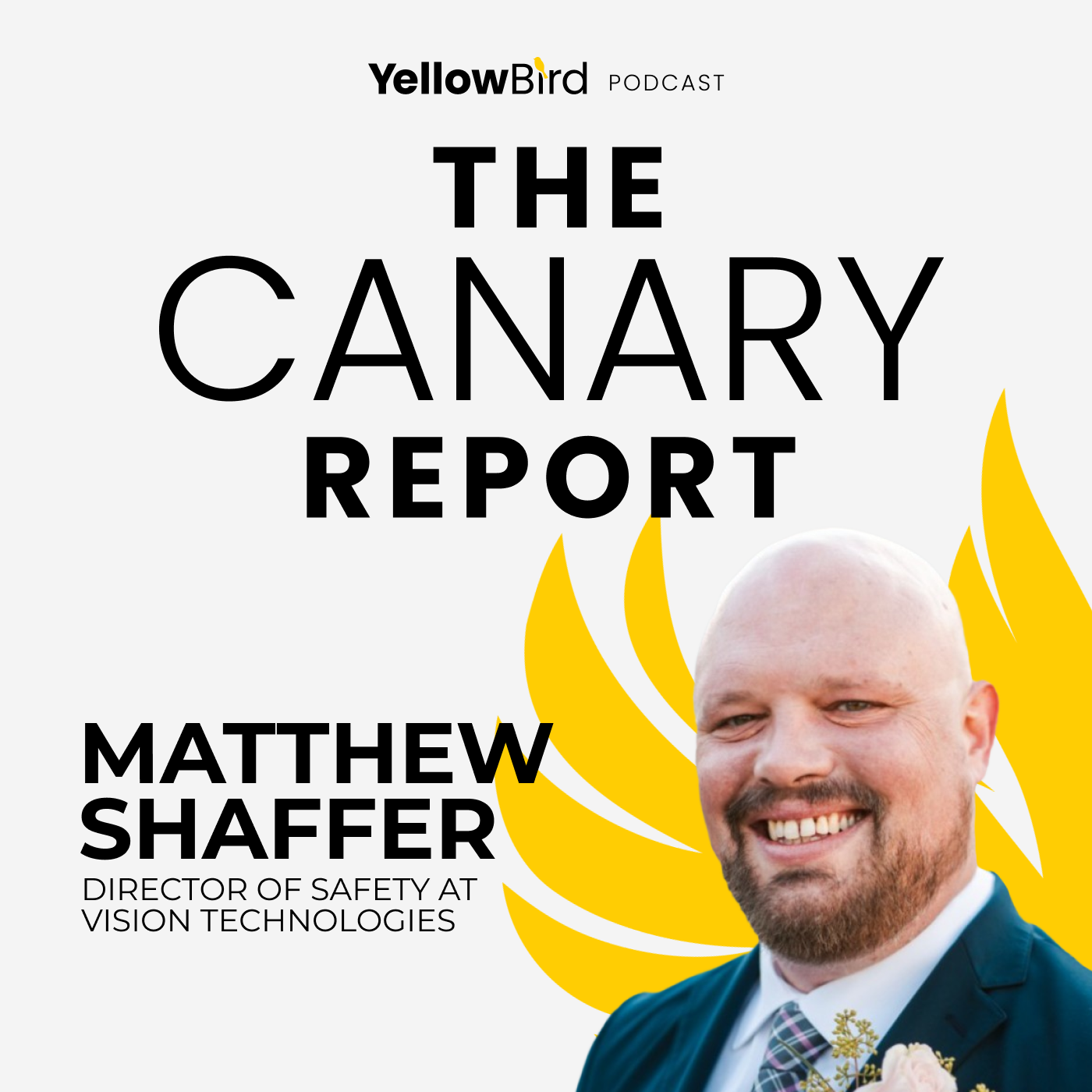
In this episode of The Canary Report: Safety & Risk Management, host Michael Zalle sits down with Matt Shaffer, Director of Vision Technologies, to explore what it takes to build safety cultures that work. The conversation revolves around the human dynamics that determine whether workers genuinely own safety or simply perform it when someone is watching.
Matt came to safety through an unconventional route: insurance, financial planning, and a phone call from a friend managing ground operations at Dulles Airport. What started as a workers' comp consulting engagement turned into over a decade of leading programs across aviation, construction, and critical infrastructure. His core belief has remained constant throughout: nobody comes to work wanting to get hurt. Your job as a safety leader is to build systems that honor that.
Eliminating "Safety Versus Operations"
Matt's most foundational move at Vision Technologies was also his simplest: getting rid of the phrase "safety versus operations."
The problem with "versus" is that it embeds a conflict before anything else has happened. Workers hear it. Operations managers hear it. And the culture that forms around it is one where safety is something imposed on people rather than something they own. Near-misses go unreported because workers don't want to draw attention to themselves. Foremen treat inspections as audits to pass rather than conversations to have. The safety team spends its energy fighting for compliance instead of building capability.
Matt's reframe is direct: we are with the operation, not a hindrance in it. We are your support and we are here to help you work smarter and go home safe. When that message is delivered consistently and backed up by how the safety team actually shows up, workers stop performing safety and start practicing it. This culture then begins to compound in the right direction.
The Return-to-Work Program That Actually Worked
One of the most instructive stories in this episode comes from Matt's time at Swissport, where he inherited a workers' compensation crisis with a cultural dimension that no audit could fix.
The company had just won a new contract but workers were unhappy about the transition. The existing injury policy made staying home comfortable enough that it had become, in Matt's words, the preferred method. Workers could claim an injury and remain at home on pay. The costs were spiraling, and the culture was treating injury as an escape route rather than something to prevent.
Matt's solution was a smarter design instead. He implemented mandatory modified duty: injured workers came in every day, stayed productive, and received their full paycheck. Workers on modified duty were moved to different parts of the facility, away from their peer groups, doing tasks that kept them engaged but removed the social comfort of their usual environment.
For those with genuine injuries, modified duty was a lifeline because it kept them connected, paid, and treated with dignity. For those testing the boundaries of the system, it was inconvenient enough that returning to full duty became the more attractive option. Workers' compensation costs dropped substantially. More importantly, the cultural message changed: staying healthy was worth it.
Redefining What a Successful Audit Looks Like
Most safety audits measure whether unsafe acts occurred. Matt measures something different: whether leadership catches and corrects them in real time.
He narrates a striking anecdote: A technician climbs a ladder without a hard hat. Before Matt can even note it, the foreman walks over and says, "Hey, you forgot your helmet, put it on." For Matt, that is a pass. The foreman did exactly what a healthy safety culture requires: he noticed, he corrected, and he reinforced the expectation without drama or blame. Measuring whether the hard hat was on when the worker stepped onto the ladder misses the point entirely. What you are actually evaluating is whether your frontline leadership enforces safety in the normal flow of work and not just when the safety team is watching.
Matt describes his approach to site debriefs as conversational and low-stakes: here is what I observed today, let us talk about it. If the same thing appears on the next visit, it is a coincidence worth noting. If it appears a third time, it is a pattern worth solving together. That rhythm of observation, conversation, pattern recognition builds accountability without blame, which is the only kind of accountability that actually sustains.
Building Safety Conversations People Don't Dread
The stereotype of the safety professional as the person yelling about PPE is a culture problem. When workers associate the safety team with confrontation, blame, and enforcement, they stop sharing what is actually happening on the ground. Near-misses go unreported. Hazards get normalized. And the safety program operates on performance data rather than reality.
Matt's approach is built on a different tone entirely. A worker forgets their safety glasses: "Hey, you forgot your safety glasses”; “Thanks." That is the whole conversation. Friendly, factual, and forward-moving. Over time, that tone creates an environment where workers feel safe raising concerns, reporting problems, and engaging with the safety team as a resource rather than an authority.
Why Fresh Eyes Solve the Blind Spots Veterans Have Stopped Seeing
When Matt moved from aviation to data centers, he was told he did not know construction. His response was measured and worth repeating: I know safety. The principles of hazard identification, risk assessment, and control implementation do not change between industries. What changes is the vocabulary and the specific hazards, both of which can be learned.
More importantly, Matt makes the case that cross-industry experience is not just adequate but actively valuable. Veterans inadvertently stop asking the foundational questions because the answers feel obvious. Someone who has never seen the problem before will ask exactly those questions, and those questions are often the ones that lead to the root cause.
This is why Matt advocates for diverse risk assessment teams. The question that gets called silly is frequently the one that matters most.
Safety as a Leadership Discipline
Throughout this conversation, a consistent theme emerges: safety culture is not built on rules, checklists, or enforcement programs. It is built on how leaders show up. How they talk about risk, how they respond to imperfection, how they recognize excellence, and how they position the safety function in relation to the work.
Matt's president at Vision Technologies asked a question during their first quarterly review that encapsulates this: "But what are we doing good?" It is a question most leaders never ask. The default is to focus on gaps, failures, and risks which are all important, but they are not the whole picture. When workers only ever hear about what is going wrong, they become defensive. When they can also see where they are winning, they stay motivated and invested in the program's success.
Safety leadership, done well, is an exercise in building trust across an organization that is already doing most things right, most of the time. It takes humility to position yourself as a partner rather than an authority. It takes discipline to keep the tone collaborative when the pressures of compliance and liability are real. And it takes conviction to celebrate a 100% audit with the same energy you would bring to investigating an incident.
The goal, as Matt describes it, is simple: build an environment where workers will be happy that safety is coming, and they will reach out to you. When you get there, you have stopped managing a safety program and started building a culture.
🎧 Listen to the full episode here:
Apple Podcasts:
https://bit.ly/4lrt69Y
Spotify:
https://bit.ly/3MWVnbK
YouTube:
https://youtu.be/CLSpfb8FqUc