The Hidden War Between Safety and Operations, and How to Fix It
In this installment of YellowBird’s Voices from the Field series, Jonathan Law shares four hard-earned lessons on building trust and shared ownership in safety.
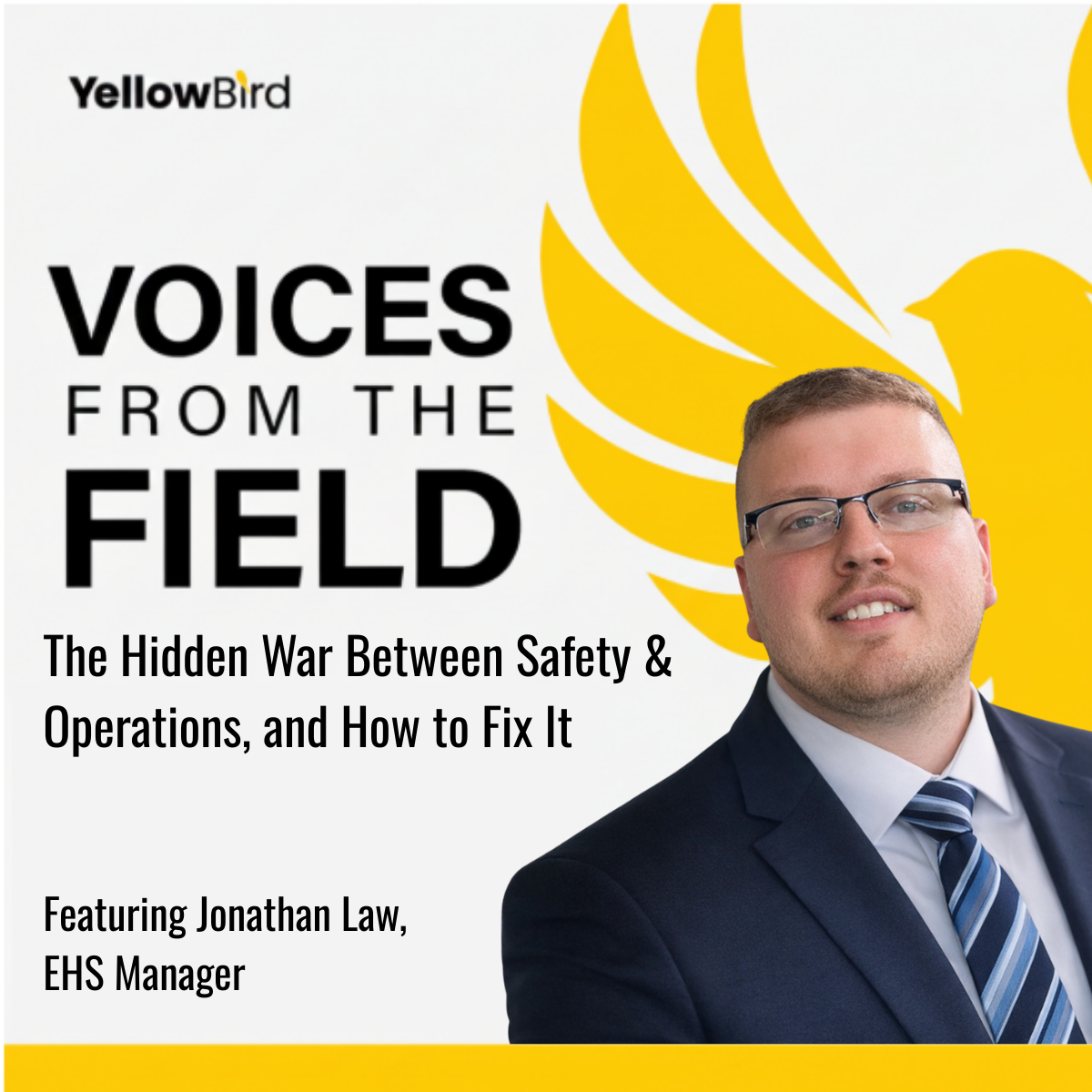
For Jonathan Law, the path to safety began on the shop floor.
As an operator in manufacturing, he watched production and safety operate like separate worlds—different priorities, different language, and a lack of trust that made everyday work harder than it needed to be. “There was a lot of disconnect between operations and safety,” he recalls. The pace was relentless, and production always had a way of taking the lead.
That experience shaped Jonathan’s career. He pursued EHS with a clear goal: become the bridge between the people doing the work and the people responsible for keeping that work safe—and make safety feel like part of the job, not an outside voice.
Today, Jonathan is the EHS Manager at Arclin. He started in early January, right as the organization began aligning practices after acquiring Polymer Solutions Group (PSG). It’s a moment when systems are shifting and habits are forming. In a transition like this, culture gets built through the choices people make. That’s why Jonathan keeps coming back to ownership.
He puts it simply: “Good safety looks like everybody owning it for themselves and those around them.”
While his story is personal, the insights translate. Here are four lessons he relies on as a leader.
Lesson 1: Safety Becomes Real Through Partnership
Early on, Jonathan assumed safety programs existed mainly to check a box. He saw safety as paperwork and someone to blame when things went wrong.
Then he stepped into EHS and found what makes progress possible: relationships and trust. That realization shaped his next move. After years as a specialist, Jonathan was ready for broader responsibility; more room to drive change and influence how work gets designed and supported.
At his new site, one early focus has been creating alignment with leadership: defining today’s reality, tomorrow’s goal, and the path between them. “We’re not going to do all this in one day,” he says. “Probably not in one year.”
How to bring this lesson to life:
- Establish credibility through consistent presence: walk the floor, learn the work, ask good questions.
- Partner with operations and engineering early, so safety improvements fit reality.
- Set a baseline and a roadmap people can see. Progress beats perfection.
Lesson 2: Approachability Builds Trust on the Floor
Jonathan’s view on enforcement-first safety is clear: it drives short-term behavior and long-term distance.
Being a safety cop, he explains, looks like walking the floor, pointing out what’s wrong, and skipping the why. People clean it up while you’re there, then return to habits when you leave. Trust erodes, and safety turns into something people do when someone’s watching.
He leads as a guide, a resource, and a collaborator. “Enforcement does not drive the best results,” he says. The work improves when employees are treated as experts in their process. “They’re the people performing the work,” he says. “They know what the hazards are… they know the equipment… they know the process.”
How to bring this lesson to life:
- Start with curiosity: Talk me through how you do this today.
- Explain the why in plain terms: what the risk is and what prevents it.
- Build solutions with the people closest to the work.
Lesson 3: Involvement Drives Results That Hold Up
Jonathan ties sustainable change to one thing: involvement.
“If you don’t involve frontline employees,” he says, “then it’s just something you’re forcing them to do.” When employees help shape the solution, they take ownership. When changes land as mandates, people work around them.
That principle matters even more during a transition. Jonathan is navigating two systems—PSG’s established routines and Arclin’s expectations—while strengthening shared ownership. His approach stays grounded: listen first, involve the people doing the work, then roll out improvements in phases.
How to bring this lesson to life:
- Ask employees what will make a change workable across shifts and conditions.
- Pull frontline voices into hazard reviews and control decisions.
- Close the loop publicly: Here’s what we heard, and here’s what we changed.
Lesson 4: Reporting Grows Through Consistent Follow-Through
Jonathan boils strong reporting down to two things: reducing fear and proving action.
“The most important thing is following through with your solutions,” he says. People speak up when they believe reports lead somewhere. Silence grows when reporting feels risky or pointless.
He also calls out how zero risk messaging can land on the floor. “People don’t want to be the one that ruined that streak,” he explains. That pressure can suppress near-miss reporting—the early signal safety leaders need most.
Jonathan is working to build a reporting culture grounded in root-cause thinking. His message to employees is clear: reporting is welcome, and investigations focus on conditions and contributing factors. “This isn’t a ‘you’re going to get in trouble if you say something,’” he tells employees. He wants to know what feels unsafe so the site can address it.
He’s also removing friction while system access rolls out during integration. For now, he’s introducing a simple paper form so employees can share concerns immediately.
How to bring this lesson to life:
- Investigate conditions first: What shaped the decision? What made this the easiest option?
- Keep learning separate from discipline so people feel safe reporting.
- Make reporting easy in the flow of work, then close the loop quickly with one visible “you spoke, we acted” win.
From Mindset to Action
Jonathan’s story is simple and powerful: he entered EHS because he knew what the floor feels like when safety is distant. Now, as a new EHS Manager, he’s building the bridge he once needed, through presence, approachability, employee involvement, and follow-through.
And when those pieces show up consistently, safety becomes a core part of how work gets done.
Build a Safety Program People Actually Buy Into
Want a multi-site safety program that works in the real world—and earns trust across teams? YellowBird connects you with exceptional safety experts on demand, nationwide. Whether you need safety training, a safety audit, or support filling a key safety role, we can help. Book a call with YellowBird today.