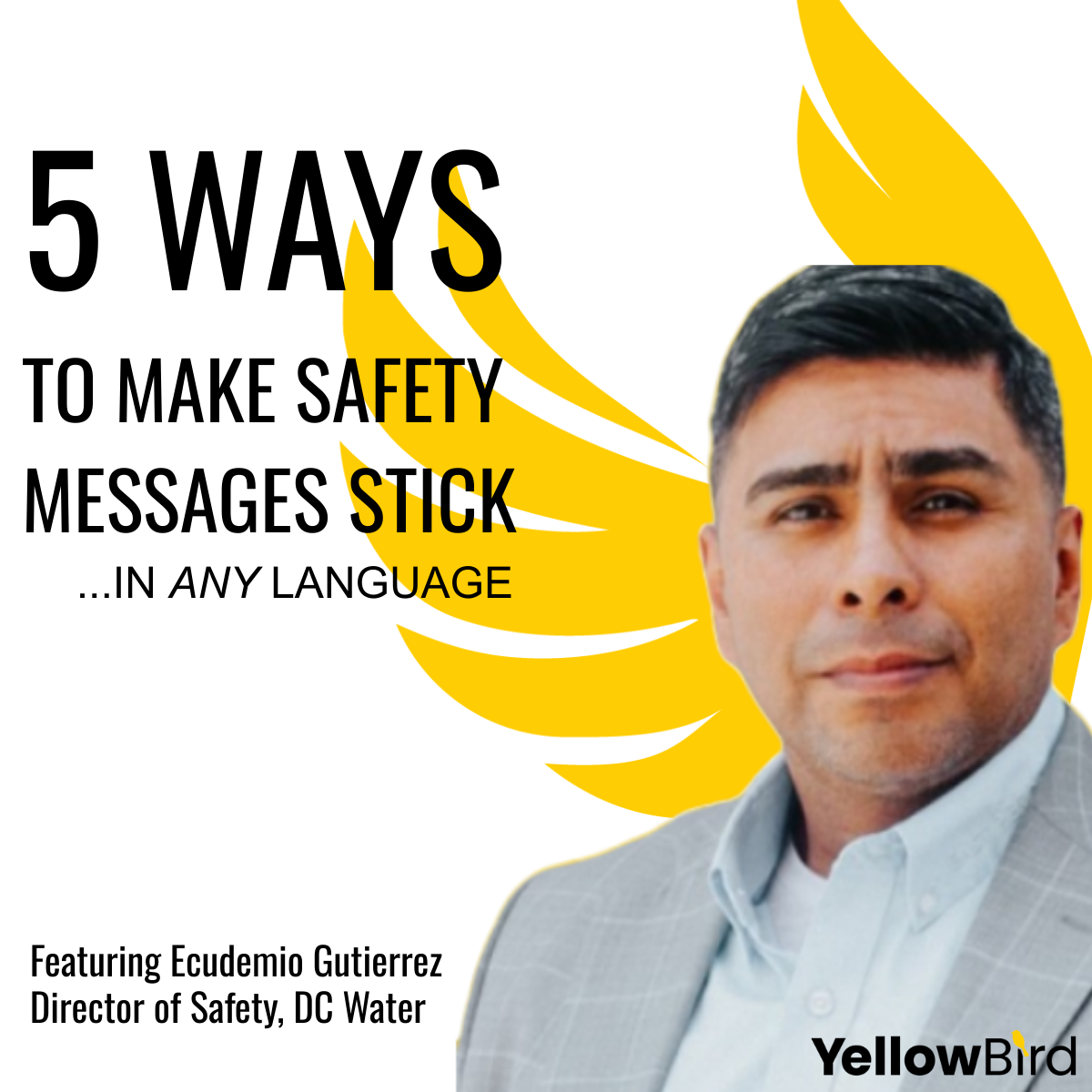
5 Ways to Make Safety Messages that Stick… In Any Language
Ecudemio Gutierrez, Director of Safety at DC Water, shares real-world moves that make safety communication clearer—and safer—across diverse workforces.
One of the biggest practical challenges companies face in the safety realm is clear communication across multilingual job sites. It’s easy to treat this as a translation problem: convert the manual, print bilingual signage, and call it progress.
On the floor, it rarely works that cleanly.
Safety terminology doesn’t always translate directly. Reading levels vary, crews rotate, and work moves fast. And when risk is highest, nobody has time to decode a paragraph—or guess what a phrase was supposed to mean.
Ecudemio Gutierrez, Director of Safety at DC Water, has spent more than 24 years building safety programs in real-world conditions—from refineries and utilities to liquefied natural gas (LNG) and infrastructure—bringing a rare mix of trade experience and behavioral science. A consistent theme in his approach: don’t confuse “translated” with “understood.”
Here, he shares five fixes that help safety messages connect across languages and literacy levels—without slowing the work down.
1. Define the Meaning First, Then Translate the Words
A minor translation choice can derail a message. Gutierrez points to a deceptively simple example: in Spanish, the word “safety” often translates closer to “security.” So, a phrase like “safety culture” can sound like “security culture”—changing the listener’s mental picture before you even get to the point. That nuance matters, says Gutierrez, who is bilingual in English and Spanish.
Start by locking in the meaning—then translate the words to match it.
What to do:
- Write a one-sentence definition for your highest-importance terms (safety, hazard, stop work, near miss, critical risk).
- Use plain language tied to outcomes people care about: health, well-being, going home safe.
- Field-test key terms with bilingual crew leads or trusted frontline employees: “What would you do next if you heard this?”
2. Stop Building a “Bilingual” Program for a Multilingual Workforce
It’s easy to assume language access is handled once you add Spanish. Many companies do exactly that—English/Spanish signage, training, and materials—and feel covered.
But many crews don’t fit that template. When your program is built for two languages and the floor is operating in five, safety turns into guesswork—sometimes with serious consequences.
One example that sticks with Gutierrez: a large warehouse operation with many Haitian workers suffered a catastrophic fire tied to improper handling of flammable materials. The safety program was “multi-language” in name only—available in English and Spanish. Many workers couldn’t read either, so critical warnings and procedures were effectively invisible.
The fix starts with seeing language coverage as an operating reality, not a checkbox—then building communication that keeps working as crews, shifts, and languages change.
What to do:
- Create a language snapshot by site and shift, and note where confusion shows up.
- Focus first on high-risk work (chemical handling, hot work, traffic control, energized equipment, confined space).
- Use visuals and short subtitled videos, so you’re not rebuilding the program every time your workforce changes.
3. Design Communication for Literacy Realities, Not Ideal Conditions
Language is only one barrier. Literacy is another—and it’s easy to miss because people often mask it. In many roles, reading isn’t the day-to-day job. People learn by watching, doing, and repeating tasks. Dense written procedures can feel disconnected from the pace of work, especially when crews are moving and pressure is high.
A program built around long documents assumes time, peace and quiet, and strong reading comprehension. The floor rarely offers any of those.
So, the goal is simple: make the safe setup obvious, visual, and easy to confirm in the moment.
What to do:
- Switch from text-heavy resources to visual-first instruction: photos, icons, diagrams, short demos.
- Replace long summaries with moment-of-work cues: what to watch for, what safe setup looks like, what triggers a stop.
- Check understanding without putting people on the spot: ask workers to show the safe setup, point out hazards, or explain the step in their own words.
4. Put Safety Guidance Where Decisions Happen
Even great training fades if people can’t access the information when the work starts.
Gutierrez’s team is rolling out a solution: two- to three-minute micro-videos workers can pull up on demand by scanning a QR code placed on equipment, signage, or near the work area. The tool can translate subtitles into roughly 30–35 languages, allowing workers to choose the language they need.
This works because it meets people at the task, right before exposure. When guidance is fast and visual, comprehension improves—and so does follow-through.
What to do:
- Start with 10–15 high-risk tasks where misunderstandings create real exposure.
- Keep each micro-video consistent: What’s the hazard? What does safe setup look like? What’s the common mistake that leads to harm?
- Place QR codes where people naturally pause before work begins: entry points, staging areas, equipment panels, task boards.
5. Verify Understanding and Close the Loop—Fast
Clear safety communication creates alignment. Unclear communication creates workarounds, partial compliance, and “good on paper” performance that falls apart in practice. The strongest programs build quick ways to confirm understanding, surface confusion early, and show teams their feedback leads to real changes.
What to do:
- Build a simple routine: after a key message, ask someone to demonstrate what “safe” looks like for that task.
- Pressure-test the message: “What could be misunderstood?” “What’s different in a real-work setting?”
- Close the loop publicly. When feedback leads to a change, say so—trust grows when people see follow-through.
Where Safety Becomes Real
These five fixes point to a bigger truth: safety communication has to hold up under real conditions. Treat language and literacy as real operating conditions, and build a system that delivers safety information in the moment—visually, accessibly, and consistently.
That’s how you reduce guessing, stop silent shortcuts, and support safe decisions at every site.
For more insights from Ecudemio Gutierrez, check out this episode of The Canary Report:
Apple Podcasts: https://bit.ly/4nK1Eoc
Spotify: https://bit.ly/46J39Nj
YouTube: https://youtu.be/7syg9SvLALs