Why World-Class EHS Lives Inside Operations: David Payton Explains
We talk a lot about “safety culture.” We build programs, roll out training, track metrics, and run audits. And yet, incidents keep happening. People still get hurt.
We talk a lot about “safety culture.” We build programs, roll out training, track metrics, and run audits. And yet, incidents keep happening. People still get hurt. Equipment still gets damaged. Margins still take unexpected hits.
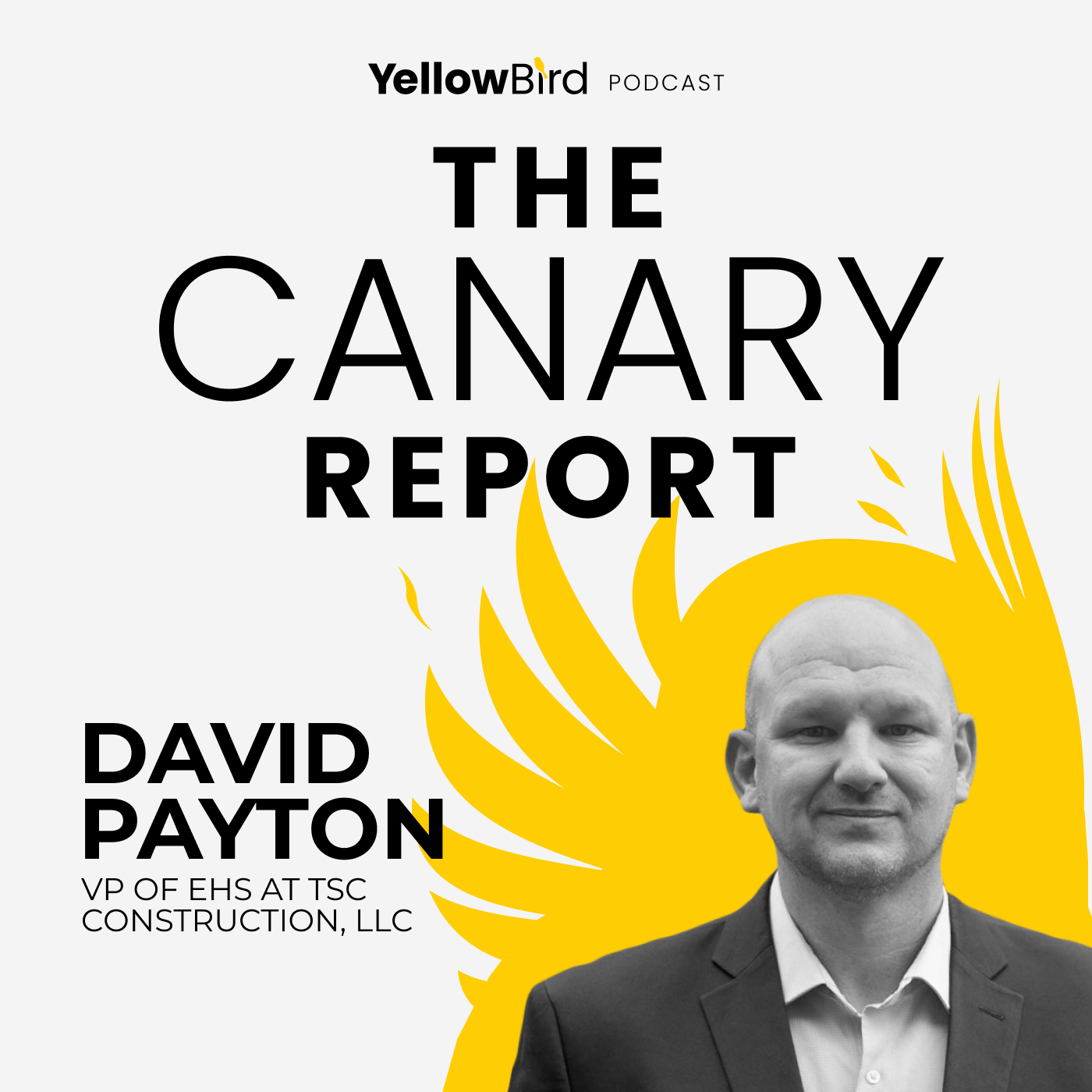
In the latest episode of The Canary Report: Safety & Risk Management, YellowBird CEO Michael Zalle sits down with David Payton, VP of EHS at TSC Construction, to unpack why that disconnect exists and why the issue isn’t a lack of safety effort. It’s the way safety is framed, positioned, and separated from operations.
David brings more than 20 years of experience across construction, maritime, telecommunications, environmental remediation, and large-scale national operations. He’s worked offshore, in shipyards, on complex remediation projects, and inside executive conversations where P&L decisions are made. And that mix matters, because David doesn’t talk about safety as a theory. He talks about it as execution.
When Safety Becomes a Silo, It Fails
One of the clearest through-lines in this conversation is simple but uncomfortable: when safety is treated as a standalone function, it will always struggle for relevance.
David has seen it firsthand. EHS teams operate in parallel to operations. Compliance programs that look good on paper but never quite land in the field. Technically correct safety leaders, but operationally ignored.
The problem isn’t intent. It’s positioning.
When safety shows up as a separate agenda, it’s perceived as friction. Something that slows work down. Something that costs money. Something that belongs to “them,” not “us.” And once that mindset takes hold, no amount of policy writing will fix it.
David’s perspective flips that entirely. Safety, in his view, isn’t separate from operations; it is operations. Right alongside quality, productivity, scheduling, and cost control. If it’s not embedded there, it won’t stick.
Stop Talking About “Safety.” Start Talking About Risk.
This is where David challenges one of the most ingrained habits in our industry: the language we use.
He’s direct about it, he doesn’t lead with the word safety. He leads with risk.
Risk to people.
Risk to property.
Risk to the business.
Risk to everything.
Why? Because risk is already how leaders think. CEOs, operations managers, and finance teams manage risk every single day. When EHS speaks that language, the conversation changes. Defensiveness drops. Engagement goes up.
David also reframes incidents in a way that forces accountability. He doesn’t talk about “safety incidents.” He calls them what they are: operational failures.
If someone rigs equipment incorrectly, that’s not a safety issue; it’s a failure in training, certification, or execution. If a crane collides with another structure, that’s not a safety event; it’s an operational breakdown. That shift matters. Because once something is labelled an operational failure, it becomes everyone’s problem to solve, not just EHS’s.
Operational Credibility Changes Everything
One reason David is able to have these conversations is because he’s lived on the operations side.
Before EHS, he worked in estimating, bidding, execution, and high-risk environments where mistakes carry real consequences. He understands P&L pressure. He understands schedules. He understands what operations leaders need to hear to connect safety decisions to business outcomes.
That credibility is critical.
When EHS leaders can talk about margins, exposure, and execution, not just compliance, it reframes safety as profit protection, not overhead. It becomes a strategic lever instead of a cost center.
And that’s when leadership starts listening.
Training That Actually Translates to the Field
We also get into one of the most practical parts of David’s work: training at scale.
At previous organizations, David was part of building centers of excellence that cost roughly $35,000 per person once travel, facilities, and instruction were factored in. That’s a serious investment, and David is clear that it only works under one condition: leadership commitment.
If hiring is sloppy, that investment evaporates.
If accountability is weak, it doesn’t pay off.
If leadership isn’t aligned, it becomes expensive theatre.
At TSC, that lesson carries forward. Training isn’t treated as a checkbox. It’s tied directly to expectations, field verification, and culture. Subcontractors go through the same training as employees, ensuring consistent competency across the supply chain.
The message is simple: training only works when organizations are honest about who they hire and serious about holding people to the standard they’re trained to meet.
Scaling Safety Without Bloated Teams
Managing risk across 23 markets introduces a different challenge: coverage without sprawl.
David walks through TSC’s hub-and-spoke training model, which combines regional training hubs with mobile subject matter experts who deploy where data shows emerging risk. High-risk tasks like rigging, rescue, and electrical work receive targeted oversight without staffing full-time specialists everywhere.
That’s paired with remote engineering support, civil, electrical, and RF, so field teams can access expertise in real time. The result is precision, not excess. Expertise goes where it’s needed most, when it’s needed most. For organizations trying to scale nationally without blowing budgets, this model offers a clear alternative to one-size-fits-all staffing.
Hiring and Partnerships as Risk Controls
One of the most provocative parts of the conversation is how David approaches partnerships.
Before TSC commits to working with an organization, David conducts executive-level interviews with company owners and leaders. This isn’t a formality. It’s a risk assessment.
Is leadership aligned with operational excellence?
Will they support training and accountability?
Or will safety be the first thing cut when pressure shows up?
Too many companies skip this step, inherit misaligned partners, and then wonder why programs fail. David’s approach flips that risk forward, qualifying fit before investment.
For anyone in advisory, consulting, or multi-employer environments, this is a powerful reminder: not every organization is ready for the kind of safety they claim to want.
The Real Takeaway
This episode isn’t about adding more rules, more training, or more dashboards. It’s about thinking differently.
When safety is framed as operational excellence:
- Accountability becomes clearer
- Resistance fades
- Investment decisions get easier
- And outcomes improve, both human and financial
David’s message is consistent throughout: stop isolating safety. Stop defending it. Integrate it into how work actually gets done.
Because when safety becomes part of execution, not an interruption to it, everyone wins.
If you’re a VP of Risk Management, an EHS leader, or an operations executive trying to move past compliance theatre and into real performance, this conversation is one you’ll want to sit with.
👉 Listen to the full episode of The Canary Report: Safety & Risk Management, and let’s keep pushing the industry toward what actually works.
🎧 Listen here:
Apple Podcasts: https://bit.ly/3LBmGaD
Spotify: https://bit.ly/49PFviH
YouTube: https://youtu.be/XbfKo0PyZaM