Why Your Safety Culture Is Defined by What You Ignore
Lessons from C.W. Driver's Jim Wathen on building a safety culture that scales across 40 active projects.
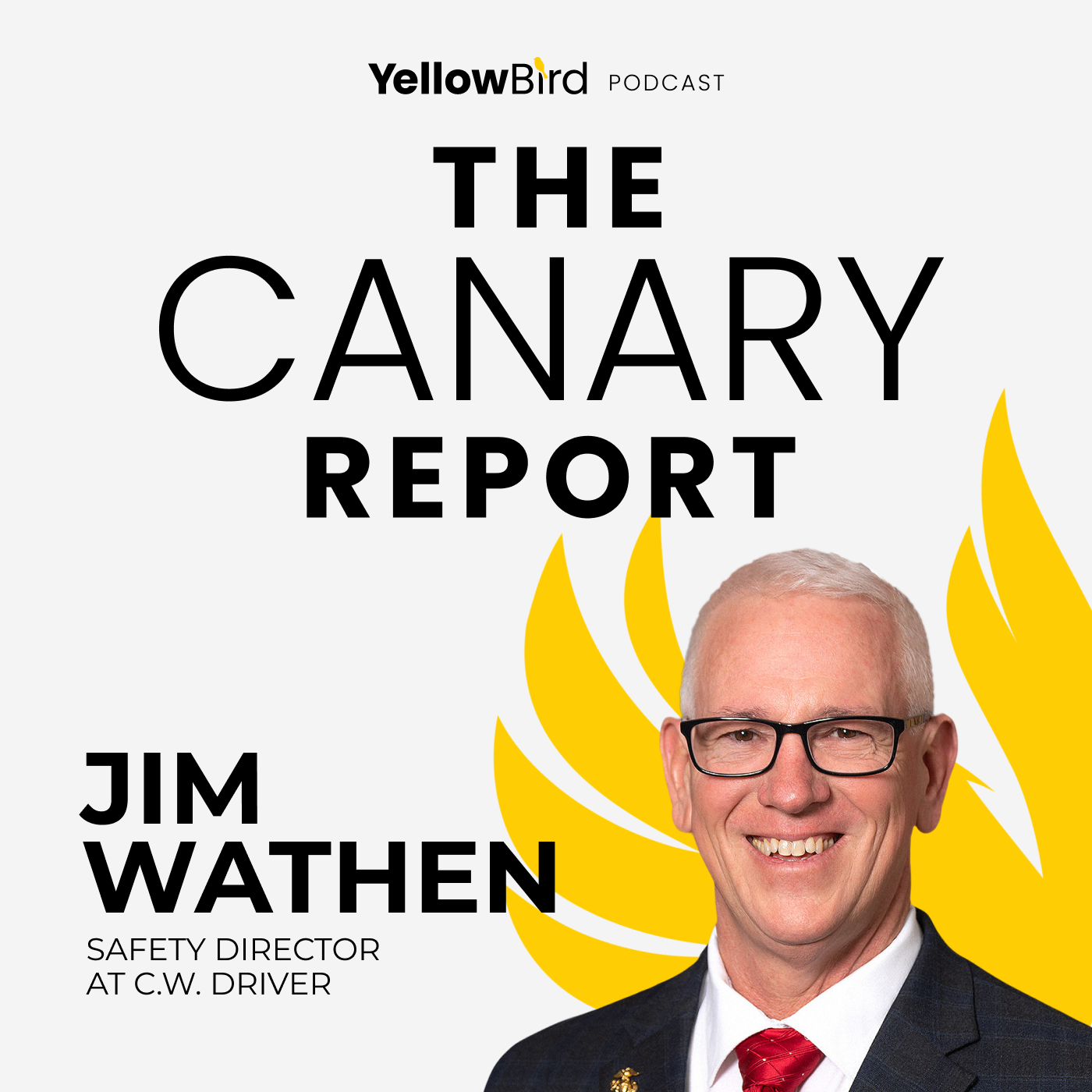
"Culture is what you tolerate. It's not what you say." - Jim Wathen, Safety Director, C. W. Driver
Jim Wathen, the Safety Director at C. W. Driver, joins host, Founder & CEO of YellowBird, on this episode of The Canary Report, and understands that safety compliance is merely a baseline for incident prevention.
Workplace safety culture depends on the leadership and programs used for risk management every single day. The identity of organizations is rarely found in the slogans on their walls or their mission statements, but is rather built on the behaviors that leaders choose to permit or ignore on the job site. By focusing on the human element of general contractor safety, Jim has transformed how his team views their responsibility toward one another over his career.
Scaling Safety Through Distributed Responsibility
"Safety is won at the job site, not in the office." - Jim Wathen, Safety Director at C. W. Driver
Risk management across a large organization requires a strategy that moves outside the walls of a small safety department. At C. W. Driver, the philosophy centers on making general contractor safety a shared responsibility for every project leader rather than a task for a single person. The company requires OSHA 30 certification for project managers, engineers, and assistants to ensure that safety leadership is present at every level of the project.
This lets a lean team of safety professionals maintain high standards across forty active job sites by empowering others to act as safety champions. When accountability is distributed throughout the leadership chain, the organization becomes resilient and capable of sustaining an elite workplace safety culture.
Prioritizing Training for Severe Construction Hazards
“Most of the training that we do from that standpoint on the jobs, it's in person. It's one of our team members and just scaffolding.”
- Jim Wathen, Safety Director at C. W. Driver
While digital platforms provide a convenient foundation for safety training programs, certain construction hazards require a more tactile approach to ensure competency. Jim emphasizes that training for fall protection is most effective when conducted in person on the job site.
Walking through an actual excavation or setting up scaffolding together builds a level of understanding that online modules just cannot match. A commitment to hazard assessment ensures that teams are prepared for the most dangerous phases of the construction schedule when the risk is highest.
The Human Connection in Risk Management
“At the end of the day, we want our people not only getting home safe, but also retiring with the same mobility and vibrance that they started in their career, and that's what safety is all about.” Jim Wathen, Safety Director at C. W. Driver
The most powerful tool for a safety professional is the ability to build genuine relationships with the people working in the field.
Taking the time to praise field teams for safe habits builds trust and long-term loyalty that no standard compliance checklist can match. When leadership signals authentic care for the individual, workers respect the environment and return to the company year after year. They build a legacy that workers carry with them to every new project.
Achieving Cal/OSHA VPP status is an honor, but Jim Wathen says that the true reward is seeing workers retire with the same vitality they had when they started their careers.
What you can put to work this week:
- Map Hazards to Project Schedules: Go from a generic inspection calendar to a dynamic model that surges safety resources during the most dangerous project phases.
- Audit Your Tolerance Threshold: Walk the field with your project managers to identify which minor infractions are being ignored to meet speed or production targets.
- Implement Observation Tracking: Ensure that every logged hazard observation requires a documented field correction to prevent the issue from repeating.
- Incorporate Specific Positive Praise: Instruct your field leadership to actively recognize and praise specific safe behaviors during daily walks to strengthen worker relationships.
Listen to the full conversation on The Canary Report to see how you can turn your team into safety champions.
Apple Podcast: https://acesse.one/93q4vkz
Spotify: https://l1nk.dev/zabqet8
YouTube: https://youtu.be/T4hZWL7HyMQ