Calculated Implosions: Technical Precision and Self-Insured Risk in Global Demolitions
What controlled demolition can teach every safety leader about risk, accountability, and the hidden work that prevents incidents.
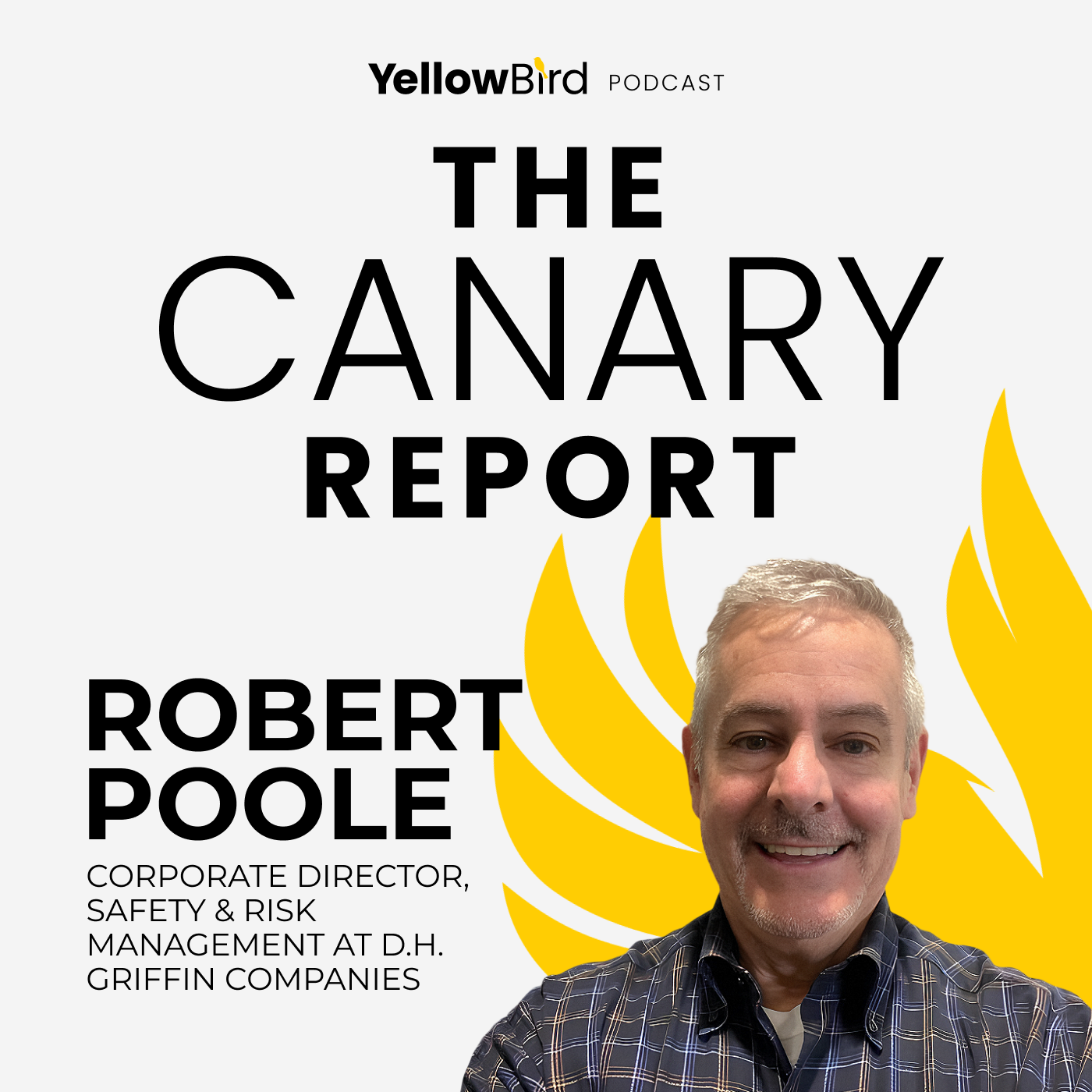
"The tower was 185 feet tall, solid steel, built to withstand the force of launching rockets. It only took about 186 pounds of explosives to bring it down." - Robert Poole, Corporate Director of Safety and Risk Management at D. H. Griffin Companies.
This isn't a scene from an action movie; it's a regular day for Robert Poole. As the Corporate Director of Safety and Risk Management at D. H. Griffin Companies, Robert oversees the surgical demolition of massive structures.
We brought him onto The Canary Report because his approach to high-stakes risk management reveals something every safety leader needs to hear: when you own the risk completely, your commitment to safety moves from a checklist to a core business necessity.
This conversation between Robert and our host, Michael Zalle, Founder and CEO of YellowBird, gets into how technical expertise and financial accountability create an exemplary safety record in one of the world's most dangerous industries.
Self-Insurance Makes Safety a Paramount Business Function
D. H. Griffin Companies operates through the largest construction captive in the United States, meaning they are essentially self-insured for workers' compensation and general liability.
For many organizations, insurance is a buffer, meaning a third party that handles the attorneys and the claimants. For Robert's team, they are taking the "first dollar hit" on every incident. This financial structure removes the middleman and forces a level of cognitive awareness that most traditional firms never reach. It's the difference between a child spending on a parent's credit card and an entrepreneur watching every cent of their own hard-earned capital.
"When you are writing the checks yourself for all the legal and everything else, you don't have somebody between you and the attorneys or the claimants. It's you. And how you deal with it and handle it, it makes a big difference when you're writing those checks and how you want to write them and who you're writing them to and how much you're writing them for." - Robert Poole, Corporate Director of Safety and Risk Management at D. H. Griffin Companies
When the money coming out of the bank belongs to the company, safety leadership becomes the ultimate protector of the bottom line. It serves as a reminder that while EHS programs are about people, they are also the most effective financial risk management tool an organization has. If you want to change the culture of your safety department, start by helping them understand the actual cost of every incident.
Success is Won in the Months Before the Explosion
Most people think a controlled demolition is about the "big boom," but the real work happens in the background, in the months leading up to it. Robert explains that a building is systematically gutted; piping, wiring, and windows are removed until only a concrete or steel shell remains. The goal is to use only the exact amount needed to make a structure fall like a tree.
"The goal here is it's like cutting down a tree but the goal is to use the least amount of explosives as possible. That's the goal. So you work as hard as you can to use the least amount. You weaken the structure significantly to help it fall the way you want it to fall." - Robert Poole, Corporate Director of Safety and Risk Management at D. H. Griffin Companies
This technical precision allowed his team to complete a launch pad demolition at Cape Canaveral in just 12 days, a project other firms estimated would take six to eight weeks. It shows that true safety and efficiency aren't at odds.
Calculating Risk Instead of Fearing It
There’s a common misconception that safety leaders are "eggheads" who are purely risk-averse. In reality, the best in our field are those who understand how to calculate risk so they can perform high-stakes work safely. Whether it’s flying a helicopter or bringing down a tower, the skill is in the calculation, not the avoidance.
"I've been cross disciplined actually in safety and risk management, which has helped me throughout my career, not just pure safety, but the risk management side of it as well. That's really paid off in my career course and my path immensely. And I'd encourage other safety people. I know you insurance is boring, but there's a lot it ties into the world." - Robert Poole, Corporate Director of Safety and Risk Management at D. H. Griffin Companies
This mindset enabled D. H. Griffin to manage a global fleet of 2,000 pieces of specialized equipment and perform work in remote regions like Mongolia. By embracing technical expertise and maintaining everything in-house, they ensure that the human story behind every job ends with everyone going home whole.
What you can take away and put in action:
- Audit your "first dollar" awareness. Even if you aren't in a captive, treat every safety incident as if you were writing the check personally to shift your team's perspective on the financial impact of prevention.
- Focus on the "gutting" phase. Before tackling a major hazard, ensure you've removed every secondary risk like the piping and wiring in a building to simplify the core problem you're trying to solve.
- Embrace microlearning. Robert’s team uses two-to-five-minute training snippets that employees can access on their phones, which has resulted in over 25,000 views and much better engagement than traditional long-form modules.
High-stakes safety relies on the months of engineering and the financial accountability that ensure the explosion goes exactly as planned.
We hope Robert's journey from the cockpit to the demolition site helps you look at your own EHS program with fresh eyes.
You can hear the full conversation about launch pads and self-insured captives on this episode of The Canary Report.