Why Crews Ignore Safety Leaders They Don’t Trust
What real-world experience teaches about trust, credibility, and getting crews to buy in.
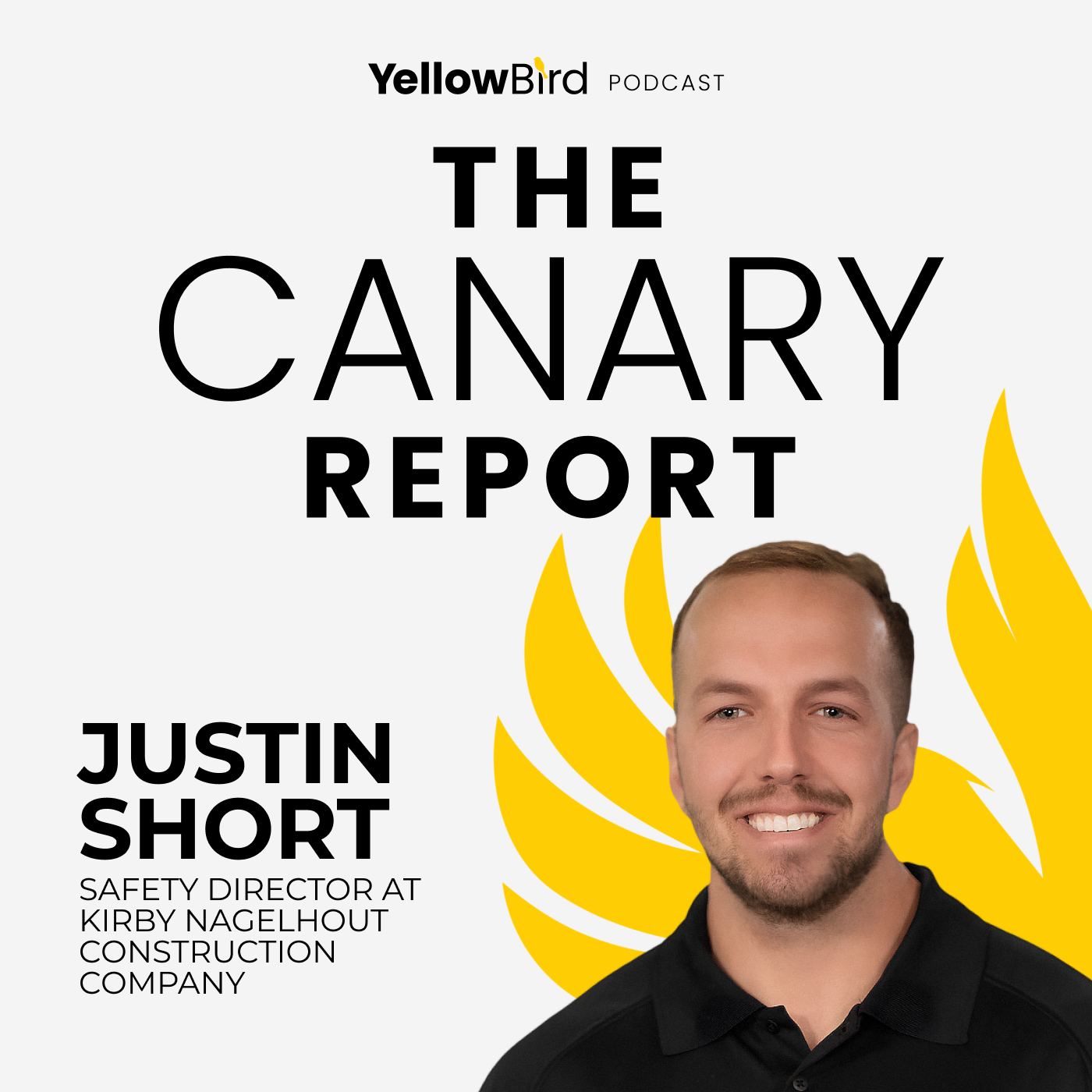
In this episode of The Canary Report: Safety & Risk Management, host Michael Zalle sits down with Justin Short, Safety Director at Kirby Nagelhout Construction Company, to explore how real-world experience shapes safety leadership. The conversation moves beyond compliance frameworks into trust, behaviour, and credibility, and how they determine whether safety systems are followed at all.
Justin’s path into safety was not linear. He started in the trades, spent seven years in the United States Air Force, stepped away from the profession entirely, and eventually returned to lead safety across dozens of active construction projects. That journey shows up clearly in how he approaches the role today.
You Cannot Fake Credibility on a Job Site
Justin describes a shift that many safety leaders recognise but few articulate clearly. The difference between being seen as “the safety guy” and being someone the field actually listens to often comes down to lived experience.
Having worked in construction himself, he understands the pace, the pressure, and the trade-offs crews make every day. That influences conversations by way of tone, language, and timing. It also builds a level of credibility that cannot be manufactured through policy or authority alone. He says that crews respond differently when they feel understood instead of managed or monitored.
The Small Things That Signal Leadership
At one point in the conversation, Justin shares a moment that captures a broader issue. A long-tenured employee was completely unknown to a senior leader. The reasoning? If someone is not causing problems, they are not worth knowing.
But that mindset has consequences.
Justin takes the opposite approach. He makes the effort to learn names, remember details, and find points of connection. Over time, those small interactions build trust, and trust changes how feedback is received. When a safety concern is raised by someone who knows you, the conversation feels different. It feels less like enforcement and more like accountability.
When Leadership Undermines Safety
Justin is candid about why he stepped away from safety earlier in his career. The issue was not the work itself but the people leading it.
He describes environments where leadership behaviour contradicted the very principles safety programmes were meant to uphold. Poor communication, lack of support, and dismissive attitudes created friction that no system could overcome.
That experience highlights what many organisations overlook. Safety culture is shaped far more by behaviour than by documentation. If leadership does not reflect the values it promotes, the system loses credibility quickly.
Managing Safety Across 75 Moving Targets
At Kirby Nagelhout Construction Company, Justin operates in a highly dynamic environment. Dozens of active projects run simultaneously, each with its own risks, teams, and constraints. The range is significant, from smaller builds to large-scale projects like a $190 million high school redevelopment. The challenge lies in this variability.
Each project introduces different hazards, different subcontractors, and different timelines. Conditions evolve daily. What was safe in the morning may not be safe by the afternoon.
Justin’s approach starts with clarity. Understand where things stand. Identify what is missing. Prioritise what matters most. Then build from there. He compares it to construction itself. You start with the foundation before focusing on the finish.
Two People, Hundreds on Site
At Kirby, Justin and one other safety professional support operations that involve hundreds of workers across sites. Since it is not possible to be everywhere, the goal shifts from direct oversight to enabling others to make the right decisions.
This is where leadership, communication, and trust become operational tools.
Justin leans into this kind of collaboration. He works closely with his team, draws on their expertise, and involves them in decision-making. He also treats field teams as partners rather than recipients of instruction. The expectation is shared ownership and safety becomes something people participate in, not something that is imposed on them.
The Moment That Defines Your Response
On a job site, situations unfold quickly. Someone is standing on the top rung of a ladder. A guardrail has been moved. A process has been skipped.
In those moments, how a leader responds matters as much as what they say.
Justin shares an example where his initial reaction was more direct than intended. He later returned to apologise, not because he was wrong about the issue, but because the delivery did not reflect how he wanted to lead.
That follow-up changed the relationship. It reinforced accountability on both sides. These moments are easy to overlook, but they shape how people perceive and respond to leadership over time.
Safety as a Byproduct of How You Lead
Throughout the conversation, one idea becomes clear. Safety outcomes are closely tied to leadership behavior. When leaders invest in understanding their people, communication improves. When communication improves, issues surface earlier. And when issues surface earlier, risk is easier to manage.
Systems, training, and compliance still matter. But none of them operate in isolation. The effectiveness of a safety programme is determined by how well it integrates with the people responsible for executing it.
Closing Thought
Across the conversation, Justin sums it up simply: his role exists because of the people in the field. Safety is no longer about controlling environments from a distance. It becomes about supporting the people who operate within them every day.
For leaders managing safety in complex, fast-moving environments, that shift is worth internalising and responding to.