Stop Fighting Fires: What Proactive Safety Leaders Do Differently
How proactive EHS leaders shift from reacting to incidents to anticipating risk, influencing the business, and preventing problems before they happen.
Safety teams are often at their best when something goes wrong. An incident happens, a near miss gets reported, or a compliance issue appears, and EHS professionals jump into action. That response is necessary. But it can't become the entire job.
For Jesse Marano, Director of Global EHS at EVAPCO, the real opportunity is helping safety teams evolve from firefighters into fire marshals. Instead of spending most of their time responding to incidents, mature EHS organizations should increasingly focus on identifying risks, understanding patterns, and preventing problems before they happen.
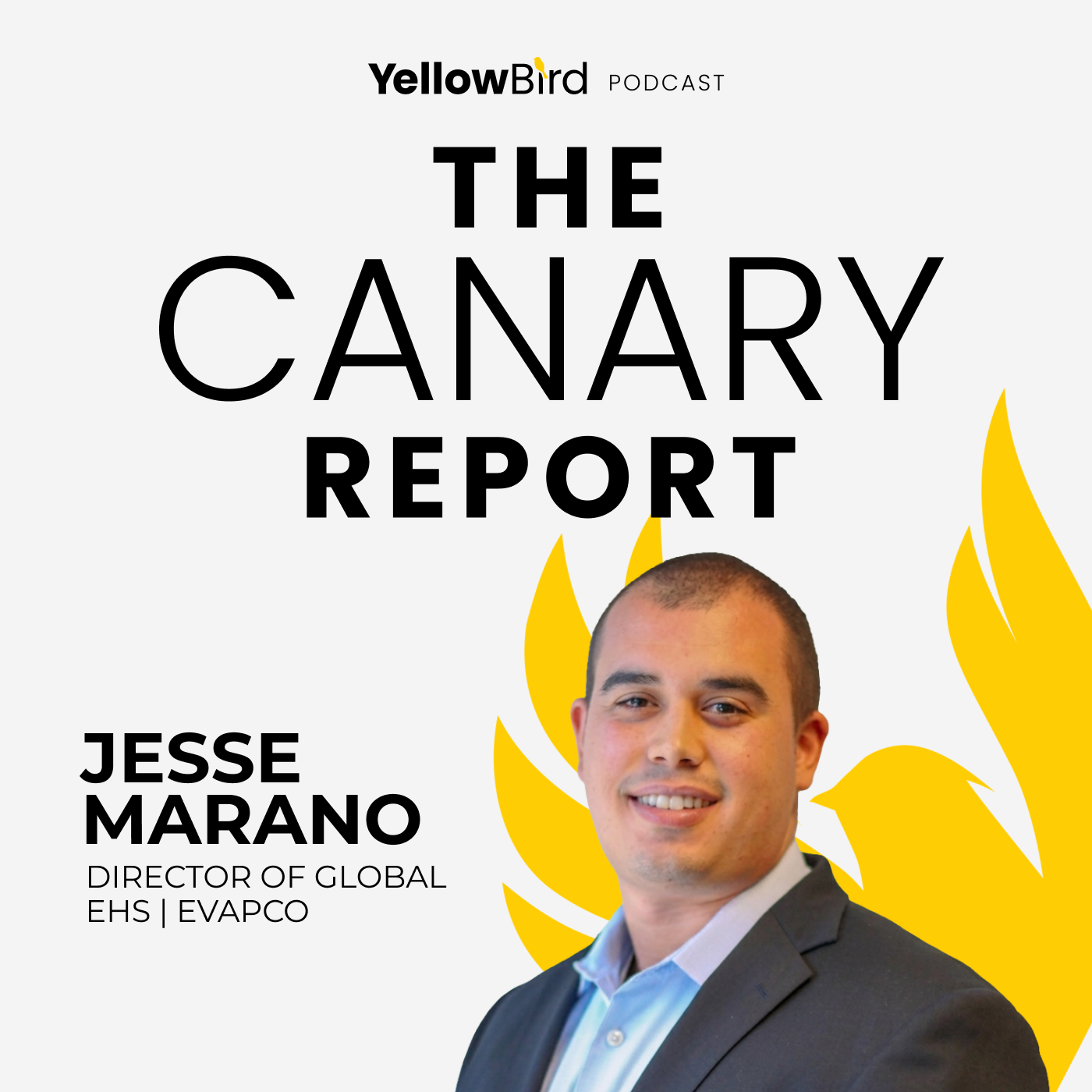
In the latest episode of The Canary Report, Michael Zalle sat down with Jesse to explore what it takes to build a proactive safety culture across 28 facilities in 13 countries. With nearly 20 years of EHS experience across manufacturing, aerospace, biotech, construction materials, and industrial cooling, Jesse brings a practical perspective shaped by both hands-on experience and global leadership.
And there are some important lessons here for anyone trying to make safety a stronger part of the business.
Move From Firefighting to Fire Marshaling
One of Jesse's most useful ideas is the distinction between firefighters and fire marshals.
EHS teams will always have to respond when something goes wrong. That's part of the job. The problem starts when incident response consumes so much time that there is little capacity left for prevention.
Jesse describes the current state of many safety teams as responding to fires. It's warranted, but it cannot be the only thing they do. The goal is to use organizational maturity to change the balance.
Instead of constantly investigating yesterday's incidents, EHS professionals can spend more time looking at near misses, maintenance patterns, ergonomic risks, recurring exposures, and other indicators that reveal where tomorrow's problems might come from.
That transition takes time. It also requires a deliberate shift in how EHS teams measure their own success.
A mature safety organization isn't simply good at responding to problems. It is increasingly good at making sure those problems don't happen in the first place.
Develop “Stra-Tactical” Safety Leaders
Jesse uses the term “stra-tactical” to describe a combination of strategic and tactical capability. It's a particularly useful concept for safety professionals because EHS leaders have to operate at two very different levels.
They need to understand what is happening on the plant floor. They need to know how work gets done, where hazards appear, and what controls are practical.
At the same time, they need to understand the broader business. They have to communicate with executives, operations leaders, finance teams, and other stakeholders about why safety investments matter.
If you're only tactical, you can become buried in the details. If you're only strategic, you can lose touch with the realities of implementation.
Jesse's own career progression demonstrates why both perspectives matter. As EHS responsibilities expand from individual sites to divisions, regions, and global operations, leaders need to develop the ability to connect hands-on knowledge with enterprise-level thinking.
That combination makes safety professionals more credible because they can explain both what needs to happen and why it matters.
Balance Global Standards With Local Expertise
Managing EHS across 28 facilities in 13 countries creates another challenge: how much should be standardized, and how much should be left to individual sites?
Too much central control can create frustration and disconnect corporate programs from local realities. Too little oversight can create inconsistent standards and compliance gaps. Jesse's approach is to find the balance.
Certain expectations should be non-negotiable. Regulatory compliance, critical hazard controls, incident reporting, and core safety standards need clear accountability.
But implementation does not always need to look identical everywhere.
A facility in one country may face different regulations, environmental conditions, cultural expectations, and operational risks from a facility somewhere else. Local teams often have the expertise needed to navigate those differences.
The role of the global EHS organization isn't to know every regulation in every jurisdiction. It is to create the structure, resources, and expectations that allow local teams to manage those requirements effectively.
That distinction becomes increasingly important as companies grow through acquisitions and expand into new markets.
Stop Speaking Only in the Language of Compliance
One of the biggest barriers to safety buy-in isn't that operations leaders don't care about safety.
It's that they are often measured on different things.
Production leaders think about output, efficiency, downtime, labor, and cost. Finance leaders think about financial exposure and return on investment. Executives think about business continuity, reputation, and enterprise risk.
If an EHS professional walks into that conversation and simply cites an OSHA requirement, they may be technically correct but still fail to communicate why the initiative matters.
Jesse believes safety professionals need to speak the language of the people they are trying to influence.
A reduction in lost-time incidents can mean less disruption. Better ergonomic design can reduce workers' compensation costs. Effective machine guarding can prevent injuries while also protecting equipment and production continuity.
The point isn't to make safety sound like something it isn't.
It's to explain the real value that safety creates in terms the rest of the business already understands.
Learn to Sell Your Safety Program
This leads to another important lesson from Jesse: EHS professionals need to develop their sales skills. That might sound strange for a safety leader. But in practice, every safety professional is selling something.
You're asking someone to adopt a new process. You're asking operations to invest in equipment. You're asking employees to change behavior. You're asking leadership to approve resources.
That requires communication. The key is understanding your customer.
A CFO, CEO, production supervisor, and frontline employee may all support safety, but they don't necessarily care about the same outcomes. Jesse encourages safety professionals to understand their stakeholders' pain points and gain points, then explain how the safety initiative addresses those priorities.
That isn't manipulation. It's effective communication.
A strong safety program still needs technical substance. But if nobody understands its value, even a great program can struggle to gain traction.
Package Safety So People See Its Value
Jesse uses a memorable example involving garbage being collected from the streets of New York City and packaged into cubes that were then sold for $100.
The example illustrates a simple principle: perception of value can change dramatically depending on how something is packaged and presented.
Safety initiatives work in much the same way.
A checklist can feel like bureaucracy. Additional PPE can feel like another requirement. A new procedure can feel like another obstacle to getting the job done.
But when the same initiative is clearly connected to a problem people care about, the perception can change.
The safety leader's responsibility isn't just to design the control. It's also to explain why it exists, what problem it solves, and what value it creates.
Good safety communication doesn't hide the requirement. It gives people a reason to care about it.
Build an EHS Team That Can Scale
Global growth also changes what a safety team needs to look like.
Jesse advocates for a lean corporate EHS structure supported by empowered site-level coordinators. That approach allows the central team to provide direction and consistency without becoming a bottleneck for every decision.
Local coordinators become more than responders. They become strategic partners who understand their operations and can identify opportunities to improve risk management.
That is an important evolution.
When EHS teams are structured correctly, the organization doesn't depend on a handful of corporate experts trying to solve every problem. Knowledge and accountability are distributed throughout the business.
That makes the safety program more resilient as the organization grows.
What You Can Put to Work This Week
- Identify one recurring fire: Find an issue your team repeatedly reacts to and look for the underlying cause you can address proactively.
- Build your “stra-tactical” skills: Spend time understanding both the operational details and the business case behind your safety initiatives.
- Separate standards from implementation: Define what must be consistent globally and where local teams need flexibility.
- Know your customer: Identify the priorities of the stakeholder you're trying to influence before presenting your safety initiative.
- Connect safety to business outcomes: Show how your recommendations can protect people while reducing costs, downtime, disruption, or operational risk.
- Improve the packaging: Explain the problem, the solution, and the value clearly so people understand why your initiative matters.
- Empower local safety leaders: Give site coordinators the authority, resources, and knowledge they need to become proactive partners.
Stop Fighting Fires
Safety leadership isn't about being the best firefighter in the organization.
It's about building an organization that needs fewer firefighters because it has become better at seeing and preventing risk.
Jesse Marano's approach brings together strategic thinking, operational understanding, communication, and practical risk management. His “stra-tactical” philosophy is a useful reminder that effective EHS leadership requires both boots-on-the-ground experience and the ability to see the bigger picture.
As organizations expand across facilities, countries, and regulatory environments, that balance becomes even more important.
The goal isn't simply to respond better when something goes wrong. It's to build the systems, relationships, and capabilities that help prevent the next incident before it ever happens.
Listen to the full conversation with Jesse Marano on The Canary Report.
Apple Podcast Link:
https://go.fame.so/apple-jesse-marano
Spotify Link:
https://go.fame.so/spotify-jesse-marano
YouTube Link:
https://youtu.be/Vg9YseBjSNo
Newsletter: https://go.fame.so/newsletter-jesse-marano