Busting the Myth of the "Irreplaceable" Safety Leader
Why the strongest safety cultures are built by training for real-world failures, and developing people who can lead long after you leave the room.
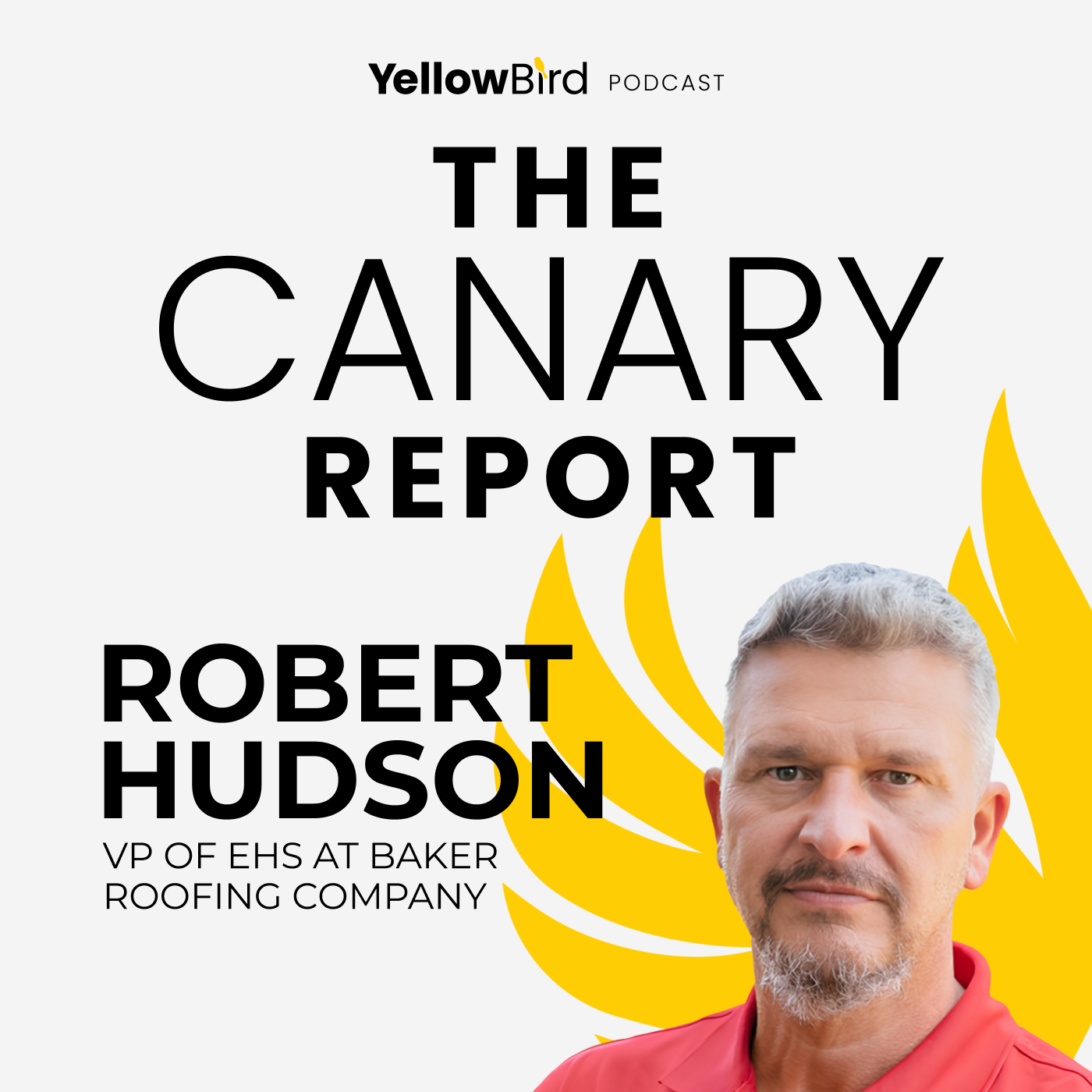
What happens to a company culture when the leader in charge of safety decides that his goal is to make himself unnecessary? In the high stakes world of roofing company safety and EHS risk management, the traditional instinct is often to hoard knowledge as a form of job security.
This week on the Canary Report, host Michael Zalle sits down with Robert Hudson, the Vice President of Environmental Health and Safety at Baker Roofing, to challenge that mindset. With eighteen years of experience overseeing twenty eight locations and a massive fleet of seven hundred and fifty vehicles, Robert has learned that the strongest organizations are built on radical transparency and intentional mentorship.
The Invisible Gaps in Standard Training
Robert shares a striking story from early in his career that illustrates the difference between checking a compliance box and truly preparing a team for the field.
While working on a military base, a rented manlift developed a hydraulic leak on the tarmac. The operator, wanting to be helpful and keep the concrete clean, made the split second decision to drive the leaking machine over a storm drain. While his intention was to hide the mess, he nearly triggered a massive environmental investigation because that fluid went directly into the groundwater.
This incident reveals a critical blind spot in many construction safety programs. We often train people on how to operate equipment safely, yet we frequently forget to teach them what to do when that equipment fails.
Robert argues that workplace safety leadership must include hazardous materials protocols and spill containment as part of standard machine certifications. When leaders share these real world stories, they help their teams understand the cascading consequences of their decisions.
Owning the Narrative Through In-House Training
One of the most impressive aspects of the safety culture at Baker Roofing is that they conduct ninety nine percent of their training in house. Robert is a firm believer that you cannot outsource your core curriculum because external vendors do not understand the specific tribal knowledge of your business. His team manages more than two million ladder trips every year, which is a level of exposure that requires specialized, proprietary instruction.
By building their own training modules for everything from skylight access to ladder safety, Robert ensures that the education remains grounded in their actual daily operations. This approach has also led to incredibly low turnover within his safety department. When professionals are treated as learners who are being developed instead of workers who are being managed, they tend to stay loyal to the organization. This internal expertise becomes a competitive advantage that generic, off the shelf training videos can never replicate.
Addressing the Highway Fatalities Blind Spot
A sobering reality of workplace safety leadership is that the most dangerous part of an employee's day often happens before they even reach the job site. Robert highlights a startling statistic: one in four workplace fatalities occurs on the highway.
Despite this, many organizations continue to treat fleet safety management as a secondary concern or a separate insurance issue rather than a core safety priority.
At Baker Roofing, the safety team treats driving with the same level of rigor as fall protection or confined space entry. This involves conducting loss control surveys, investigating fender benders for systemic patterns, and ensuring that every driver understands the weight of their responsibility on the road. By bringing vehicular risk under the same umbrella as operational safety, leaders can begin to address the primary cause of fatalities in the industrial sector.
The Power of Relinquishing Control
Perhaps the most human moment of the conversation comes when Robert discusses his personal transformation and his philosophy on legacy. He shares how he moved from a sedentary lifestyle to a rigorous morning routine that helped him lose weight and eliminate the need for blood pressure medication.
This personal discipline translates directly into his professional life, where he has learned the importance of giving away his power to empower others.
For ten years, Robert ran the company safety committee by himself, but as his responsibilities grew, he realized he could no longer do it all alone. When he finally stepped back and allowed a committee of his team members to take the lead, they produced a work product that was better than anything he had ever created on his own.
Robert believes that if you grow the people underneath you, they will not push you out, but instead they will push you up.
Listen to the full episode to hear how this comes through. True leadership is about shortening the learning curve for the next generation and making your impact felt long after you have left the room, hear why:
Apple Podcast: https://bit.ly/4tE0i0v
Spotify: https://bit.ly/4tA256u
YouTube: https://youtu.be/vcqpYNv6Tv0