Why Your EHS Management System Is Your Ultimate Operational Playbook
Learn how Kyndryl safety leader Jeff Schmitt, CSP, builds EHS management systems to protect global IT teams across 60 countries.
When your company spins off from a corporate giant, your safety framework does not automatically tag along.
That was the reality Jeff Schmitt, CSP, faced when Kyndryl separated from IBM in 2021. Their ISO 45001 certification did not carry over. Schmitt had to evaluate operational risks and build a health and safety management system from scratch across 60+ countries. From his roots in a 52-person high school class in Fowler, Michigan, to managing global IT infrastructure, Schmitt knows safety requires a practical, hands-on structure.
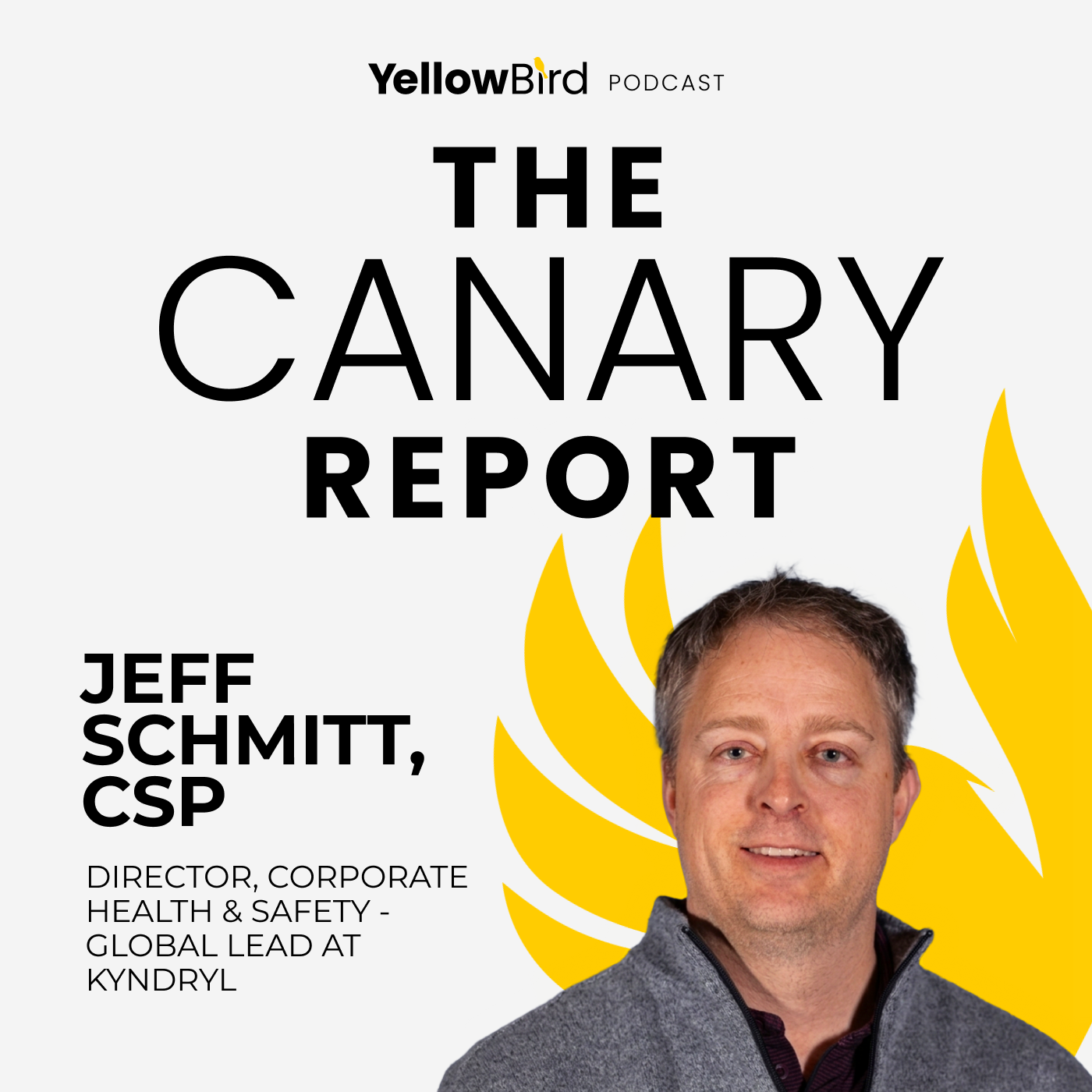
In a recent episode of The Canary Report, YellowBird’s founder and CEO, Michael Zalle, sat down with Schmitt, now Director of Corporate Safety and Health at Kyndryl. Schmitt shared how treating safety as a structured playbook protects global teams and drives continuous operational improvement.
Safety Belongs to the Whole Village, Not Just EHS
A safety department can draft policies, but a small EHS team cannot oversee every worker across 60 countries on its own. Managing complex IT operations requires active involvement across every level of the organization.
When leaders demonstrate real commitment and frontline employees actively participate, compliance transforms into true ownership. Schmitt emphasizes that a safety management system only works when everyone takes personal responsibility.
"If the system really works, the employees are doing the right thing. Their leaders are doing the right thing and committed to health and safety as well. So it's really a village. It's not just the health and safety team village; it's the entire corporation and company." —Jeff Schmitt
When frontline workers, contractors, and executive leaders share accountability, safety shifts from an administrative obligation into an embedded organizational habit that keeps everyone protected.
Your Management System Is Your North Star
Operating across remote environments, customer facilities, and high-risk data centers brings unique challenges. High-risk settings where electrical hazards or power transfers occur demand robust controls, clear procedures, and strong contractor networks.
A health and safety management system acts as a central playbook for navigating these environments. It provides the baseline structure needed to protect internal employees and extended contractor networks while adapting to new hazards.
"One of the themes that I can see that's helped me in my career and it's helped me with my global team now is around having a plan and playbook and essentially our health and safety management system is our playbook. That's our guide. That's our North Star to direct us to be able to continuously improve." —Jeff Schmitt
Having a clear, structured framework provides stability during operational shifts, ensuring safety teams can evaluate risks and adjust controls without losing their overall strategic direction.
Curiosity Drives Lifelong Operational Improvement
Whether managing a single manufacturing facility or a global workforce, effective EHS leadership requires relentless curiosity. Asking questions, seeking feedback, and learning from mentors allows safety leaders to spot operational gaps before incidents occur.
Maintaining an open mindset ensures safety programs evolve alongside changing operational environments. Schmitt even applies this management system mindset at home when planning family trips to Belize and Costa Rica.
"In the health and safety field, if you're new to it, if you've been in it for 20 years, 30 years, always be curious, always have that opportunity to improve. And really having a strong management system helps do that." — Jeff Schmitt
Staying curious keeps safety programs dynamic and effective, preventing operational fatigue while driving long-term safety performance across every stage of a career.
What You Can Put to Work This Week
- Treat your safety management system as a living playbook: Use your EHS framework as a guiding North Star to direct continuous improvement rather than treating it as static paperwork.
- Build shared corporate accountability: Partner directly with business leaders and frontline workers so safety responsibility is shared across the entire enterprise rather than isolated within the EHS team.
- Address customer and contractor site risks: Ensure employees and external contractors working at third-party locations are trained on host-site hazards and have clear channels to raise safety concerns.
- Maintain active professional curiosity: Regularly evaluate operational processes and encourage your team to ask questions regardless of how long they have been in the safety field.
Safety work is ultimately about people going home whole to their families at the end of every day. Having a clear plan and playbook gives organizations the confidence to manage risk effectively and adapt to whatever comes next.
Listen to the full conversation with Jeff Schmitt on The Canary Report.
Apple Podcast Link: https://go.fame.so/M2ufW7tX
Spotify Link: https://go.fame.so/T6c6739W
YouTube Link: https://youtu.be/rA_VGrI8_n8
Newsletter: https://go.fame.so/_wRNxo05