Why All Your Safety Activity Isn’t Making People Safer: A Conversation with Steve Davis
Five connected elements. One resilient system. A practical framework for reducing serious injuries.
Safety leaders are often surrounded by activity programs, metrics, training, and audits, yet still struggle to achieve the outcomes that matter most. Despite significant investment and good intentions, injuries continue to occur, near-misses repeat, and safety teams are left wondering why all that effort isn’t translating into real protection.
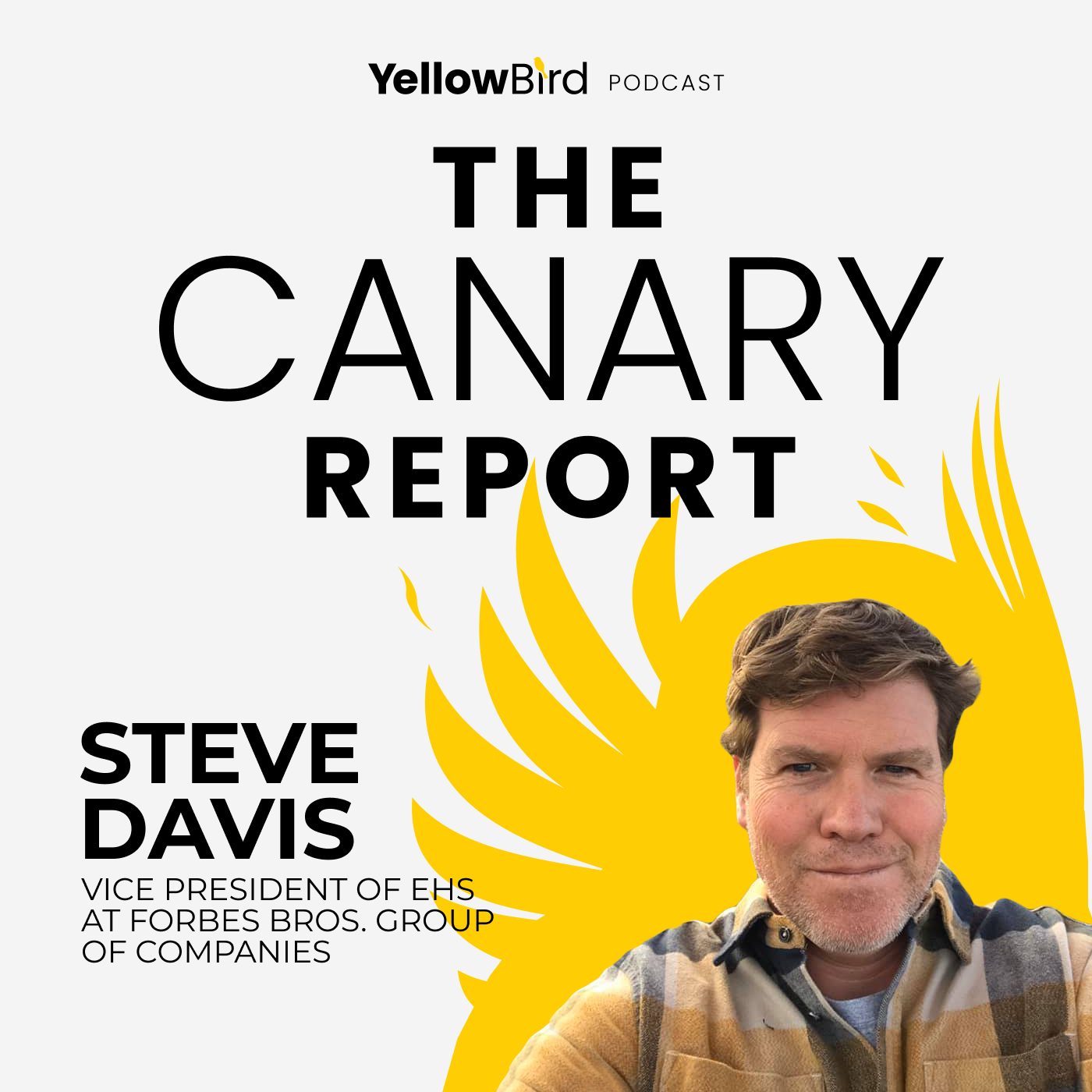
That tension sits at the heart of this episode of The Canary Report: Safety & Risk Management, where host Michael Zalle sits down with Steve Davis, Vice President of EHS at Forbes Brothers Companies, for a grounded, experience-driven conversation about what actually makes safety work in high-risk environments.
Rather than advocating for more rules or credentials, the discussion focuses on alignment and why disconnected safety initiatives quietly undermine even the best-designed programs.
The Hidden Cost of Fragmented Safety
Most organizations don’t lack safety activity. What they lack is connection. Training may exist in one lane, incident investigations in another, metrics tracked separately, and communication delivered sporadically. Organizational support leadership attention, time, and budget often fluctuate. On paper, this can look like progress. In practice, it creates blind spots and confusion.
Steve points out that safety programs frequently operate in isolation. They may be well designed, but without reinforcement through processes, metrics, and communication, they become forgettable. The result is what many safety professionals recognize as compliance theater: visible effort with limited behavioral impact.
Frontline teams feel this disconnect immediately. When workers can’t see how reporting hazards leads to change, or how lessons learned shape future training, engagement fades not from apathy, but from lack of clarity.
A Five-Element Framework for Real Protection
A pivotal moment in the conversation comes when Steve explains how his thinking crystallized during a long flight, as he reflected on why certain safety efforts consistently produced better outcomes. What emerged was a simple but powerful framework built around five interconnected elements:
- Programs
- Processes
- Metrics
- Communications
- Organizational Support
None of these elements is new on its own. What makes the framework effective is how deliberately they are connected. The more connection points between these elements, the stronger and more resilient the safety system becomes.
Michael underscores that safety excellence doesn’t come from doing more; it comes from ensuring that what already exists works together. Alignment, not activity, is what transforms safety from paperwork into protection.
Redefining Safety Culture Through Choice
A central theme of the episode is the meaning of safety culture. Steve offers a definition that cuts through abstraction: culture is a repeatable pattern of discretionary behavior.
In other words, culture is revealed in what people choose to do when no one is watching.
This is why Steve challenges the industry’s reliance on lagging indicators such as injury rates and audit scores. While these metrics have value, they often fail to show whether trust, engagement, and ownership are actually growing.
Instead, he points to voluntary “good catches,” near-misses, and hazards reported before anyone gets hurt as one of the most reliable leading indicators of real culture. Crucially, these reports must remain voluntary. The moment they become quotas, they lose their integrity and turn into another form of compliance.
When good-catch reporting rises naturally over time, it signals something meaningful: people believe speaking up makes a difference.
Treating High-Energy Hazards Differently
Another critical insight from the episode is the importance of separating high-energy hazards from routine injuries. Steve explains that organizations often dilute their focus by treating all incidents as variations of the same problem.
A minor cut and an arc flash, however, are not comparable. High-energy hazards, including electrical contact, arc flash, falls from height, and heavy equipment interactions, carry fundamentally different risks and consequences.
These hazards require deeper investigation, different controls, and more deliberate upstream prevention. When organizations segregate these risks and apply proportional rigor, they gain clearer insights and significantly reduce the likelihood of serious injuries and fatalities.
The Power of a Two-Minute Pause
One of the most practical tools discussed in the episode is the “Take Two” practice, a short, voluntary pause before work begins. The tool asks four simple questions focused on task clarity, expectations, experience, and potential failure points.
Its effectiveness lies not in complexity, but in timing. By prompting reflection just before hands-on work starts, Take Two interrupts assumptions and surfaces hazards while there is still time to act.
Because it is voluntary and low-friction, it encourages participation rather than resistance. When leaders celebrate the hazards caught through this pause, it reinforces the behavior and strengthens trust.
Why Stories Outperform Data
Steve also addresses a frustration shared by many safety professionals: carrying significant responsibility without formal authority. In these conditions, influence becomes more important than credentials or analysis.
The conversation challenges the assumption that more data leads to better decisions. Charts, graphs, and reports may demonstrate rigor, but they are rarely memorable. What people remember are stories, moments that connect risk to real human outcomes.
Micahel and Steve emphasize that safety messages must be distilled into clear, human takeaways if they are to change behavior. A compelling soundbite or story will travel further and last longer than even the most detailed analysis.
Safety Leadership Is a Sales Role
One of the episode’s most candid observations is that safety leadership is, at its core, a sales role. Safety leaders must sell ideas to executives who never see the injuries that didn’t happen, to supervisors balancing competing priorities, and to frontline teams wary of the next “initiative.”
People don’t buy methodologies; they buy meaning. When safety leaders learn to lead with stories, connect safety to business outcomes, and show how protection supports performance, resistance softens. At that point, safety stops being a defensive function and becomes a leadership capability.
Why This Episode Matters
This episode of The Canary Report: Safety & Risk Management offers clarity for leaders navigating complex, high-risk environments. It challenges outdated thinking without oversimplifying the work and provides practical frameworks that can be applied immediately.
By shifting the focus from activity to alignment, from enforcement to influence, and from data overload to human connection, the conversation between Michael Zalle and Steve Davis reframes what effective safety leadership really looks like.
For organisations serious about reducing serious injuries and building cultures that last, this is a conversation worth hearing.
🎧 Listen here to the full episode here:
Apple Podcasts:
https://bit.ly/3MEyLMM
Spotify:
https://bit.ly/4colYIH
YouTube:
https://youtu.be/eHwvRe4ytIs