7 Ways to Position Safety as a Strategic Asset, Not a Cost Center
How safety leaders can turn EHS programs into a driver of risk reduction, operational performance, and business value.

Why are investments in safety always treated like overhead… and optional?
Safety leaders know that strong safety programs prove their value through events that never happen. The injury avoided. The shutdown prevented. The audit finding corrected before it becomes a bigger problem. But it’s hard to show the value of a non-event.
The key is in how we talk about safety investments. Metrics are often reported in a way that doesn’t connect clearly to business outcomes. TRIR, DART, near misses, corrective actions, and training completion rates matter, but executives may not immediately understand how those numbers affect margin, uptime, retention, insurance, customer commitments, or operational risk.
A lean EHS team may also be responsible for multiple sites, shifting regulations, audits, training, incident investigations, contractor safety, leadership reporting, and day-to-day problem solving. When safety leaders are forced into reactive mode, it becomes harder to build the kind of proactive safety program that earns strategic influence.
So how do you communicate this value when safety investments are scrutinized?
7 Steps to Make Safety a Strategic Asset
Step 1: Translate Safety Metrics Into Business Language
Safety leaders don’t need to abandon traditional safety performance metrics. They need to translate them. Executives may not always respond to “we need more audits” or “our corrective action closure rate is behind.” But they’lll pay attention to the business meaning behind those statements.
Here’s the rundown:
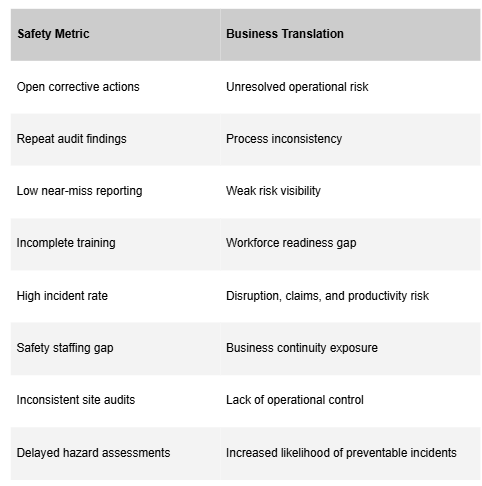
This is especially important because OSHA defines leading indicators as proactive, preventive, and predictive measures that show how safety activities are performing and reveal potential problems before incidents occur. These indicators help safety leaders answer the question executives actually care about:
Where are we exposed and how can we fix it before it impacts our bottom line?
Step 2: Move From Reactive Safety to Proactive Safety
Reactive safety waits for something to happen. Proactive safety looks for weak signals before they turn into incidents.
OSHA’s recommended practices describe safety and health programs as a proactive approach to preventing workplace injuries, illnesses, deaths, and the financial hardship these events can cause for workers, families, and employers.
For safety leaders, that means shifting the internal conversation from:
“Here is what happened last month.”
to:
“Here is where we have risk building, and here is what we are doing before it becomes an incident.”
A proactive safety management approach may include recurring site audits, hazard assessments, improved worker participation, corrective action tracking, refresher training, contractor safety reviews, and regular program evaluation.
OSHA’s recommended practices also emphasize management leadership, worker participation, hazard identification and assessment, education and training, and program evaluation and improvement as core parts of an effective safety and health program.
This is where a safety audit program becomes more than a compliance activity. Done well, audits create operational visibility. They help safety leaders identify patterns, compare locations, prioritize resources, and show executives where risk is being reduced.
Step 3: Make the Cost of Inaction Visible
One of the hardest parts of safety leadership is proving the value of prevention.
- Nothing happened, so did the investment work?
- No one got hurt, so was the extra audit necessary?
- The site stayed operational, so did leadership really need to fund additional EHS support?
This is the strange psychology of safety: success can look like absence. That is why safety leaders need to make the cost of inaction visible.
OSHA’s Safety Pays estimator is designed to help employers assess how occupational injuries and illnesses can affect profitability by factoring in injury costs, indirect costs, profit margin, and the sales required to cover those costs.
The strategic message is simple: The cheapest safety program is rarely the least expensive one.
Underinvesting in safety may appear to save money in the short term, but it can create greater exposure through lost productivity, medical and claim costs, replacement labor, project delays, overtime, investigation time, supervisor distraction, training rework, legal exposure, failed audits, lower employee trust, and reputational damage.
Safety ROI is not only about reducing injury costs. It is about protecting the organization from avoidable friction.
Step 4: Build a Safety Business Case Executives Can Understand
To reposition safety as a strategic asset, safety leaders need a business case that connects risk reduction to operational value.
A useful safety business case has four parts.
- Identify the business risk
Don’t start with the safety activity. Start with the exposure. For example:
“We’ve inconsistent safety coverage across 14 locations, which makes it difficult to identify hazards, compare site performance, and ensure corrective actions are completed consistently.”
- Explain the operational consequence
Translate the exposure into business terms. Such as:
“If this continues, we increase the likelihood of preventable incidents, audit findings, project delays, claims costs, and leadership surprises.”
- Recommend the safety intervention
Now introduce the solution. Here’s an example:
“A recurring safety audit program would give us consistent visibility across sites and help prioritize corrective actions before issues become incidents.”
- Define the executive-level outcome
End stakeholder meetings with value. For example:
“The goal is not just better audit documentation. The goal is fewer operational disruptions, better risk visibility, and a more consistent safety standard across the business.”
This is the difference between asking for “more safety budget” and presenting a plan to reduce operational risk.
Step 5: Prioritize Controls That Reduce Risk at the Source
Not all safety interventions create the same level of protection. NIOSH’s hierarchy of controls ranks ways to control hazardous workplace exposures, with elimination, substitution, and engineering controls generally more effective because they reduce exposure without relying as heavily on individual human behavior. Administrative controls and PPE can also reduce exposure, but they are lower in the hierarchy.
This matters because executives often hear safety requests as disconnected activities: more training, more PPE, more inspections, more signage. The hierarchy of controls gives safety leaders a more strategic way to explain decisions.
Instead of saying:
“We need to retrain everyone again.”
A safety leader can say:
“Training is part of the solution, but the higher-value opportunity is to reduce the exposure itself. We should evaluate whether the hazard can be eliminated, substituted, engineered out, or controlled more reliably before relying only on worker behavior.”
That is a more mature business conversation. It shows that safety is not simply asking for more activity. Safety is prioritizing interventions based on risk reduction.
Step 6: Treat Safety Expertise as Scalable Infrastructure
Many companies do not have a safety commitment problem. They have a capacity problem.
The internal EHS team may know exactly what needs to happen, but they may not have enough people, time, local coverage, or specialized expertise to execute quickly across every site. That is where flexible EHS staffing and safety consulting services can become strategic infrastructure.
YellowBird connects organizations with pre-vetted, insured, and certified safety professionals, and services include support for temporary staffing assignments, audits, training sessions, and ongoing compliance work.
For safety leaders, the strategic value is speed and flexibility. A traditional hiring process may be appropriate for a permanent leadership role. But when a site needs immediate audit support, temporary coverage, a specialized trainer, or help closing program gaps, waiting weeks or months can create unnecessary exposure.
Flexible EHS support allows safety leaders to fill safety staffing gaps quickly, support internal teams during peak demand, bring in specialized expertise, standardize work across locations, maintain momentum on audits and corrective actions, and avoid pulling senior safety leaders into every tactical task.
Step 7: Build a Safety Culture That Shows Up in Daily Operations
Every company says it cares about safety culture. The real question is whether safety culture survives contact with production pressure.
A safety culture becomes operational when workers can report hazards without fear, supervisors reinforce safe work under pressure, corrective actions are tracked to completion, training is tested in the field, safety expectations are consistent across locations, and leaders fund prevention before failure.
This is where safety becomes a competitive advantage. Not because the company says “safety first,” but because the organization has built the habits, systems, and reinforcement loops that make safe performance repeatable.
A strong safety dashboard can help reinforce that culture. Lagging indicators still matter, but by the time a lagging indicator appears, the event has already happened. A more strategic dashboard should include leading indicators, open corrective actions, repeat findings, training effectiveness, worker participation, safety staffing gaps, and business impact indicators such as downtime or project delays.
Safety becomes a cost center when it is treated as paperwork, training completion, and incident response. It becomes a strategic asset when it gives the business better visibility, stronger control, fewer disruptions, and more confidence in the way work gets done.
Need Flexible EHS Support?
YellowBird helps organizations connect with vetted safety and risk management professionals for audits, training, assessments, safety staffing, and policy development. For safety leaders who need to scale capacity without slowing down the business, YellowBird provides a faster way to get elite, qualified EHS support anywhere in the nation, whenever you need it.