Sustainable Safety, Human Leadership, and the Power of Culture with Stew Murphy
This is a conversation about sustainable change, leadership that starts on the ground, and the uncomfortable questions.
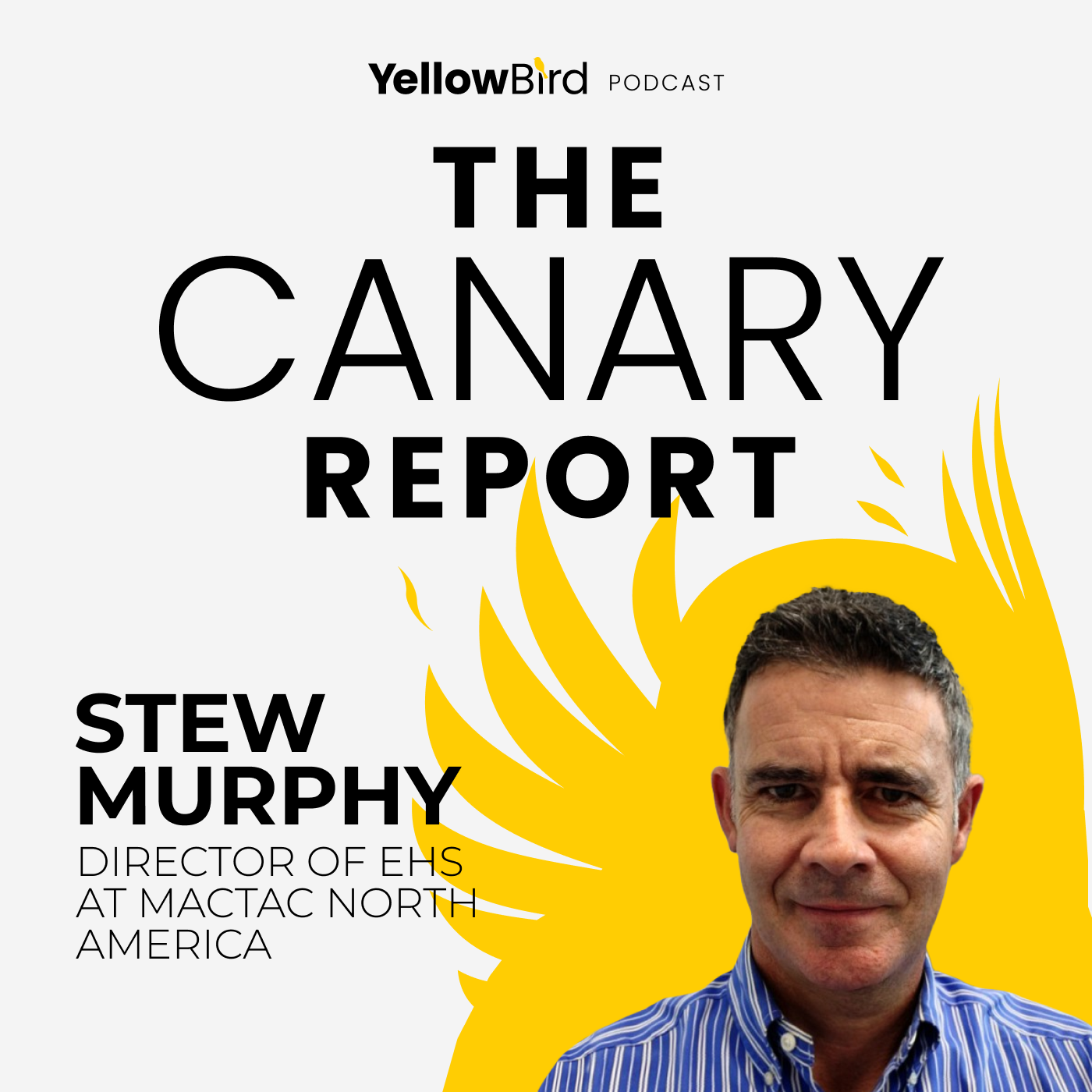
In the latest episode of The Canary Report: Safety & Risk Management, I sit down with Stew Murphy, a seasoned engineering and EHS leader and Director of EHS at Mactac. Stew shares how naturally safety excellence grows when it is grounded in humility, curiosity, and human connection.
Stew’s journey across continents, industries, and organizational cultures offers a rare perspective: safety isn’t simply a function, a department, or a compliance exercise; it’s a living, evolving ecosystem shaped every day by real people making real decisions. What makes his story so engaging is not the impressive metrics or accolades (though there are plenty), but the deeply human philosophy that has guided him for two decades.
This is a conversation about sustainable change, leadership that starts on the ground, and the uncomfortable questions that transform even the most resistant workers into safety champions.
An Engineer at Heart, Always
Stew begins with something that becomes a recurring thread throughout the episode: identity. “I’m an engineer,” he says plainly. “I’ll always be an engineer, regardless of my job. You can’t take it away from me.”
He spent the first 17 years of his career in a brewery, yes, with free beer, he jokes, which taught him more than just process engineering. Those years grounded him in the practical realities of frontline work: machines, systems, downtime, mistakes, and human behaviour. He later moved into project engineering for an American company before unexpectedly stepping into a six-month temporary role in EHS.
Those six months have now lasted twenty years.
What’s striking is how seamlessly engineering and safety merged in his mind. For Stew, safety isn’t about checklists; it’s about how things actually work. It’s a systems mindset, shaped by years in environments where theory is irrelevant if reality doesn’t cooperate.
A Pioneer of Remote Work, and a Student of Culture
Long before remote work became a global necessity, Stew was living it. Since 2006, he’s been working remotely across multiple countries, travelling, observing, learning, and absorbing cultural nuance.
“Culture matters,” he says. “It shapes how people think about risk, how they respond to leadership, how a message lands.”
While overseeing nine sites across different European countries, he saw firsthand how culture influences safety outcomes. More importantly, he learned how to respect those differences while still pushing toward a common standard.
When he first took responsibility for these locations, the combined recordable injury rate was 17. With patience, persistence, and partnership, he brought it down to 2. But the real impact, the one that still brings him pride, came years later.
Just recently, a former team member reached out with a simple LinkedIn message:
"We’ve just hit 15 years without a recordable injury. One-five."
For Stew, this was the ultimate validation. Not because it proved the metrics, but because it proved the culture endured. Sustainable safety outlives leadership turnover. It embeds itself in the day-to-day. And it is built on relationships, not directives.
When Resistance Meets Reality: A Simple Question That Changes Everything
One of the most memorable parts of the episode is Stew’s approach to dealing with employees who stubbornly refuse to change unsafe habits. Instead of escalating, threatening, or preaching, he asks a single question:
"Could you bring your daughter to work and teach her to work exactly the way you do?"
The effect is immediate. He describes watching the colour drain from someone’s face in silence. Not because they’re in trouble, but because the truth becomes undeniable. They wouldn’t want their own child copying their shortcuts. They instinctively know the risks. They know the consequences. And in that moment, the conversation shifts from defensiveness to honesty.
This is safety leadership at its most human: not compliance enforcement, but value activation. People don’t change because a rule exists—they change when something deeper is awakened.
Safety as a System, Not a Department
Throughout the episode, Stew returns to a theme that resonates strongly with the mission of The Canary Report: safety cannot live in a silo. When organizations treat safety as a department, it becomes a task somebody else handles. When they treat it as a system, interconnected, behavioural, cultural, it becomes the responsibility of everyone.
Stew’s biggest belief is that leaders must stay close to the work. Safety doesn’t happen in offices, dashboards, or meetings. It happens in the field, shoulder to shoulder with the people performing the tasks.
As he puts it: “World-class safety doesn’t get built from behind a desk. You have to be there. You have to understand the work, understand the constraints, and understand the people.”
This philosophy powered his ability to drive sustained cultural change, not through authority, but through presence.
The Quiet Power of Sustainable Change
If there is one idea that encapsulates Stew’s leadership, it is sustainability, not in the environmental sense, but in the behavioural one. Anyone can force change for a quarter. Anyone can tighten compliance for a year. But sustainable change is slow, patient, relational work. It takes emotional intelligence, cultural sensitivity, and humility.
It’s no surprise that the achievement he cherishes most is not a project milestone or an award, but a message from a former colleague celebrating 15 injury-free years. That is the legacy of a systems thinker. It is the legacy of someone who sees safety not as a checklist but as a culture that must be nurtured.
A Leadership Philosophy Built on Humanity
Stew’s stories throughout the episode reinforce a consistent leadership pattern:
- Lead with values, not fear.
- Ask better questions instead of issuing more rules.
- Stay close to the work.
- Respect culture while shaping culture.
- Build systems that outlast you.
He doesn’t describe himself as a safety guru or a culture architect. But through conversation, it becomes clear, he is exactly that. His approach is grounded, practical, and profoundly human. And that is precisely what makes it effective.
Why This Conversation Matters
In an era where organizations often chase digital dashboards and complex frameworks, Stew reminds us that the heart of safety remains unchanged: people.
His stories offer a blueprint for leaders who want to create workplaces where safety is lived, not laminated. They show that the most powerful interventions are sometimes the simplest questions. And they demonstrate how sustainable culture change happens, not through mandates, but through shared values and honest conversations.
This episode of The Canary Report is more than a case study; it’s a call to rethink how we approach safety, leadership, and operational excellence.
🎧 Listen to the full episode on The Canary Report: Safety & Risk Management:
Apple Podcasts: https://bit.ly/4aG72F1
Spotify: https://bit.ly/48KTLIO
YouTube: https://youtu.be/-gPpayOVYyY