Safety Budget Planning: How to Make the Case for Coverage Next Year
Budget season rewards the safety leader who walks in with a clear ask, a real price, and a plan for the gaps. Here's how to build that request before the numbers lock.

Picture the budget meeting in late October. Finance has a spreadsheet, operations has a list of machines it wants, and you've got fifteen minutes to explain why safety needs more than last year. If the ask sounds like "we're stretched," it usually gets trimmed, because everyone in the room is stretched.
The safety leaders who get funded come in with something different. They bring a short list of real gaps, a price for each one, and a clear picture of what happens to the work if the gap stays open. That's what a good EHS budget request looks like, and you can build it in about a week.
Why "One More Headcount" Keeps Getting Cut
The default ask is one more full-time safety person, and it's an easy line for finance to cut. It's a fixed cost that lasts for years, the search can take a quarter, and one person still can't cover an audit crunch, a medical leave, and a second site at the same time.
Run the math the way your CFO will. BLS puts the median pay for occupational health and safety specialists at $90,150 as of May 2025. Benefits made up 30.0 percent of private employer compensation costs in June 2026. As a rough estimate, benefits make up about 30% of total compensation for private employers, so a $90,150 salary works out to roughly $129,000 a year once benefits are in, and that's before travel, a truck, and recruiting.
Sometimes a permanent hire really is the right call, and if it is, work with EHS recruiters who know the field. Just don't make it the only option on the page.
Start With Exposure, Not Activity
Leadership funds risk that's been named and sized, not a list of activity. So before you talk about inspections or training hours, list where your coverage is thin:
- Sites with no regular safety presence
- Audit, monitoring, and permit deadlines on the calendar
- Planned leave, likely turnover, and open seats
- Project starts, shutdowns, and new lines that need a safety lead
Give each gap a site, a month, and a rough number of days. If you need help framing safety as a strategic part of the business, our post on positioning safety as a strategic asset lays out the full approach.
Put a Dollar Figure on the Gap
Leaders have heard the injury speech before, so keep the numbers plain and sourced. The National Safety Council puts the cost of a medically consulted work injury at $48,000 in 2024, counting lost wages, medical bills, and administrative costs. That's one injury, and it's a number most CFOs can picture.
OSHA's Safety Pays program adds the costs that don't show up on the claim. It notes that indirect costs are usually uninsured, and its estimator applies a multiplier of 4.5 to claims under $3,000. Those are the hours lost to investigations, overtime, and retraining a replacement.
Then add the costs that are specific to you, like a delayed project start, a client audit that slips, or an insurer's recommendation that stays open. Our post on how smart safety investments protect your people and your premiums covers the premium side.
David Doggette, Director of Safety at LPX Group, put it simply on The Canary Report podcast: "it's gonna cost a little money to stop and do it correctly, but if you look at the cost of doing it incorrectly, typically, you know, your safety falls right in line with your quality."
Price the Coverage Line Item: On-Demand vs. Full-Time
Now turn each gap into a line that says how many days, where, and at what rate. A simple table like this makes the comparison easy to read.
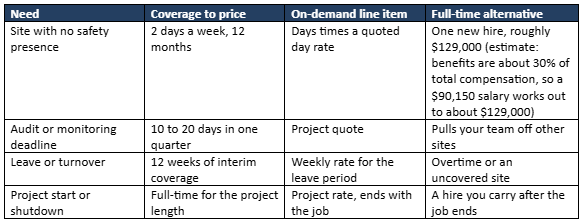
Get real quotes for the on-demand column so the numbers hold up. EHS safety staffing priced by the day or week turns into a safety staffing budget line that grows or shrinks with the work. If you're worried about keeping your standards when outside professionals are on site, our enterprise playbook for outsourcing safety without losing control walks through it.
Show the Safety ROI in Your Leadership's Language
Here's the challenge with the return on investment for safety programs. Blake Baldwin, Director of Logistics, Strategy, and Integration at Tyson Foods, named it on The Canary Report: "safety is a tricky one because you invest the money. How do you know if you prevented an injury? So sometimes a tough sell on that."
The way through is to tie money to measures your leaders already track. Leading indicators like inspections completed, corrective actions closed, and near misses reported show the work is happening. Our post on why leading indicators matter explains how to pick them. Then lead with one decision and one price, the way we describe in why your CEO doesn't care about your safety report.
OSHA's business case for safety backs you up. It notes that employers who invest in safety can expect lower workers' comp and medical costs, and often see better productivity and financial performance.
A One-Page Budget Request Template
Keep it to one page, one line per gap. Here's a layout finance can read in two minutes.
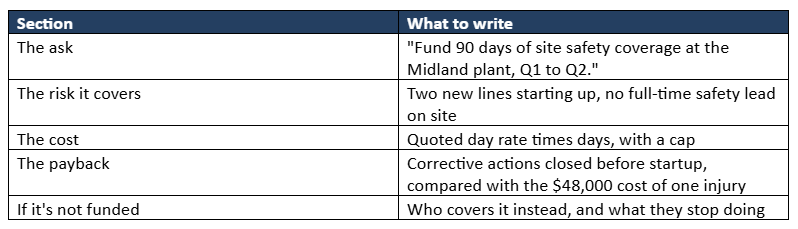
The last line matters most. When leaders see that the plant manager would be running safety on top of production, the tradeoff gets real fast. Tom Garske, President and CEO of Garske Consulting, made the same point about project work on The Canary Report: "when you lose a day or two and maybe it does cost a little bit of money, the big picture is that you need to do those things to make sure the project overall stays successful."
What to Do If the Budget Comes Back Short
A short budget doesn't end the conversation. It just means you get specific about what comes first.
- Rank the gaps by risk. Fund the sites and deadlines where the exposure is highest, and say in writing which ones stay open.
- Use money that would go unspent. Many departments have Q4 dollars left, and our post on closing safety gaps before year-end shows how to put them to work.
- Ask for a pilot. Ninety days of coverage at one site, with leading indicators reported monthly, is an easy yes, and it gives you proof for the next round.
- Set a check-in date. Put a midyear review on the calendar so the gaps you couldn't fund get a second look.
FAQ
How much should a company spend on safety?
There's no single percentage that fits every company. Build your number from your exposure, meaning your sites, deadlines, and gaps, then price each one.
How do you justify a safety budget to leadership?
Name the gap, put a sourced dollar figure on it, and show what happens if it isn't funded. Keep it to one page.
What's the ROI of a safety program?
It shows up as injuries that don't happen, projects that start on time, and lower insurance and claim costs. Track leading indicators so you can show the work behind it.
Is it cheaper to hire a full-time safety manager or use contract safety professionals?
For steady, year-round work at one site, a hire often makes sense. For seasonal, project, or multi-site gaps, paying only for the days you need usually costs less.
What belongs in an EHS budget?
People and coverage, training, monitoring and sampling, equipment, software, and a reserve for audits and surprises.
How do you present safety spending as an investment, not a cost?
Tie every line to a business outcome your leaders already care about, like uptime, project dates, or insurance renewal.
Bring a Plan Your CFO Can Say Yes To
You know where the gaps are better than anyone in that room. When you need prices for the coverage lines, YellowBird can quote on-demand safety professionals by the week, month, or project, with most requests filled in 24-72 hours once the proposal is approved.